Before you sign a single document at the notary, open an account in a Spanish bank, or pay your first tax, you will need one thing — NIE. This is the very number without which a real estate transaction in Spain simply cannot be completed. For a buyer from abroad, obtaining the NIE often becomes the first bureaucratic barrier on the way to a home by the Mediterranean Sea — and, as practice shows, it is the barrier where most people stumble.
Good news: the process itself is simple and inexpensive. Bad news: there are several pitfalls that can cost you weeks. Let's go through everything step by step.
What is NIE and why is it needed
NIE (Número de Identificación de Extranjero) is a personal identification number for foreigners in Spain. It is needed not only for buying property: without it, you cannot open a bank account, sign a long-term rental contract, arrange utilities, or pay taxes.
The key point that alleviates most fears: NIE is not tied to residency. You can obtain it as a non-resident specifically for purchasing real estate, without becoming a tax resident of Spain or moving there. The non-resident number alone is sufficient for the transaction.
The format of the number is always the same: a letter (X, Y, or Z), followed by 7 or 8 digits, and another letter at the end — for example, X1234567A. And one more detail that reassures many: the NIE number is assigned for life and does not expire. Even if you leave Spain for years, the number remains yours forever. Only the document on which it is printed may expire, but not the number itself.
Do not confuse NIE with TIE. NIE is your number. TIE (Tarjeta de Identidad de Extranjero) is a physical resident card for non-EU citizens, on which your NIE is printed along with your photo. For buying real estate as a non-resident, you do not need the TIE card — only the number.
Three ways to get NIE
There are exactly three routes, all using the same application form (EX-15) and the same state fee. The difference is only who, where, and how submits the documents.
Route 1 — at the Spanish consulate in your country. You submit the application without traveling to Spain. The consulate usually issues the number in about three weeks, although times depend on the specific office and appointment queue.
Route 2 — in person in Spain, at a National Police station (Comisaría de Policía Nacional) with a foreign affairs department. In small towns, the number is sometimes issued the same day; in large provinces, waiting can stretch to one or two weeks. The main bottleneck here is not the process itself but getting an appointment (cita previa), which can take longer than everything else combined.
Route 3 — by power of attorney, through a lawyer or representative in Spain. You sign a notarized and apostilled power of attorney at home, and your representative obtains the NIE for you while you remain in your country. This is the most convenient option for buyers who need the number before completing the transaction but cannot come early. This route is most often chosen by our non-resident clients.
Step-by-step process
Let's break down the most common scenario for a property buyer.
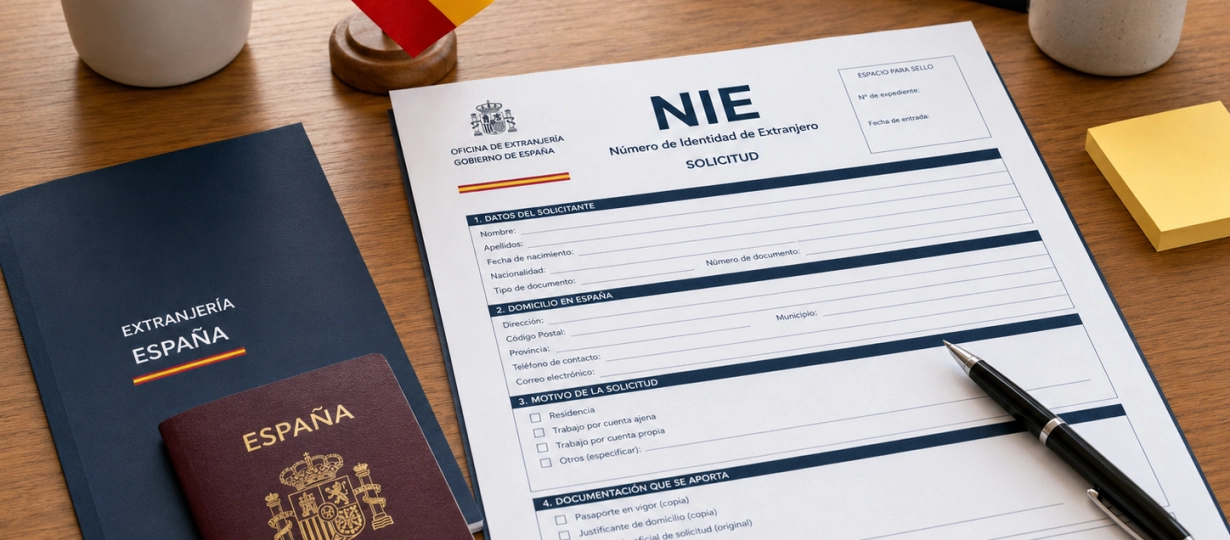
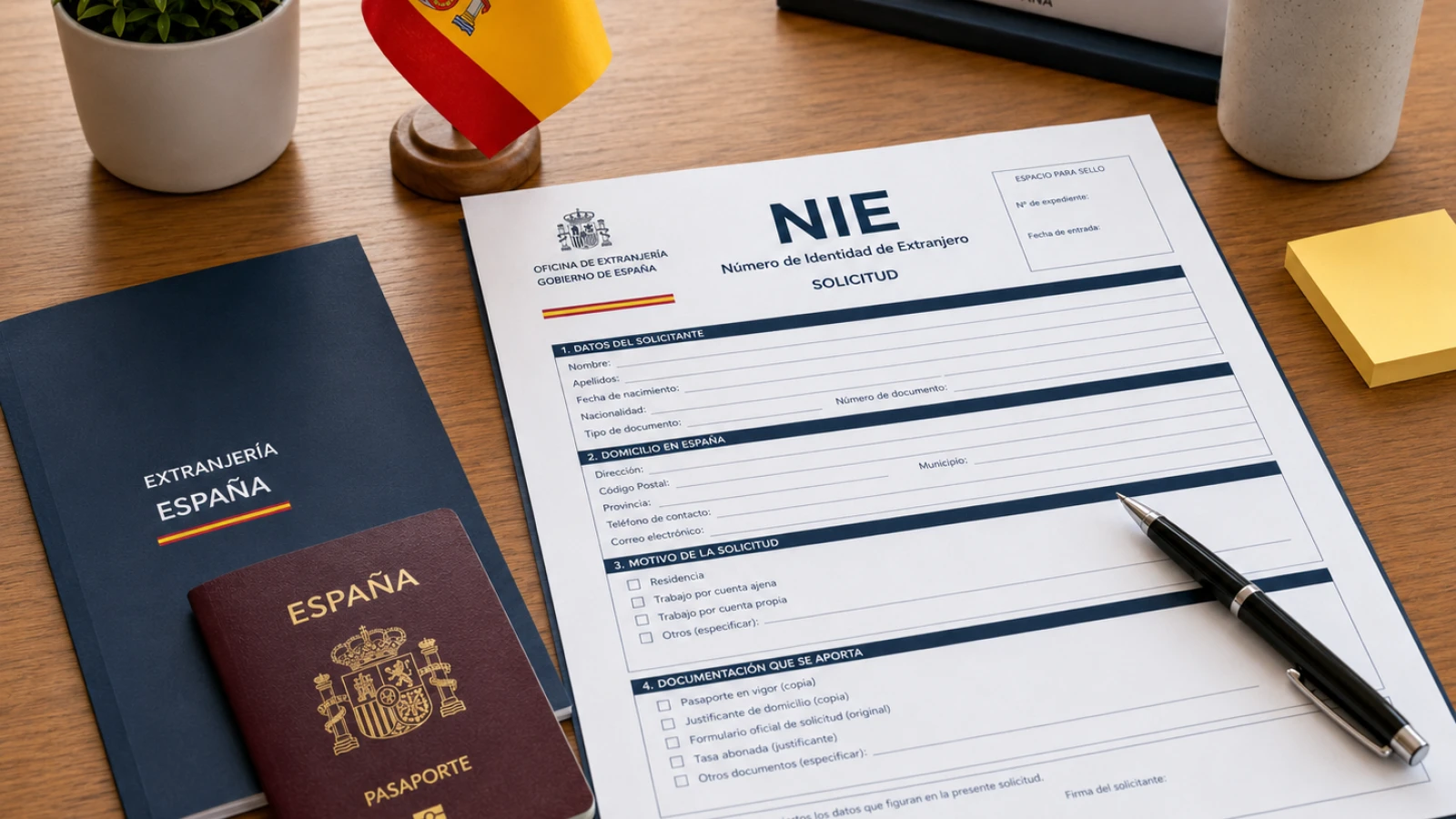
Step 1. Fill out form EX-15. This is the official application for obtaining NIE. The form is only in Spanish. Enter all personal data — surnames, first name, date and place of birth, citizenship, address, contacts — exactly as shown in your passport, character by character. In the section about the reason for the request for property purchase, indicate economic interest ("interés en adquirir una propiedad en España"). Important detail: do not sign the form in advance — the signature is placed in the presence of an official.
Step 2. Pay the state fee. The fee is processed through form Modelo 790, code 012. The fee amount in 2026 is 9.84 euros. The form can be generated on the tax service website (sede electronic administration), selecting "Tasa 012." Payment is made in any Spanish bank (BBVA, Santander, CaixaBank, etc.) in cash or by card, after which the bank stamps the form. Keep the stamped original receipt — without proof of payment, the appointment will not take place. When submitting through the consulate, the fee is paid on site.
Step 3. Gather documents. Standard package: completed EX-15 form; valid passport (original plus copy of photo page — better yet, copies of all pages); one recent passport-sized photo; document confirming the reason for the request (e.g., preliminary purchase agreement — contrato de arras — or written justification of intent to buy property); stamped Modelo 790 receipt of payment. Practical advice: Spanish offices want both originals and copies of everything. Take more copies than you think you need.
Step 4. Make an appointment (cita previa). The appointment is made through the central government portal (sede.administracionespublicas.gob.es): choose the province, the required police station, and the service. Here lies one of the main traps — the menu has several similarly sounding items. You need the item about NIE assignment ("Asignación de NIE"), not "Certificados UE" or "Recogida." Check available slots regularly: in big cities, spaces fill up very quickly.
Step 5. Attend the appointment. Arrive 5–10 minutes early. Hand over the documents to the foreign affairs officer, sign the form in their presence, answer any questions. Be patient — queues can be long even with an appointment.
Step 6. Receive the NIE certificate. When submitting in person at the police station, the certificate is often issued the same day or within a few working days. After that, the number is immediately ready for use — for the bank, the transaction, and taxes.
Common mistakes that cost weeks
Experience of transaction support shows that almost all delays boil down to the same short list. Incorrect code in Modelo 790 — make sure it is code 012, not 052 or another. Lack of copies — bring originals and copies of everything. Signing EX-15 beforehand instead of in front of the officer. Wrong service type chosen in the cita previa system. And discrepancies in data: the name on the form, receipt, and passport must match exactly.
Also remember foreign documents. If any document requires legalization, it will need an apostille and sworn translation into Spanish — this adds time and costs better planned in advance.
How much it costs and how long it takes
The state fee itself is symbolic — 9.84 euros. Additional expenses arise only if you hire a lawyer or gestor, or if sworn translations and apostilled power of attorney are needed. For buyers obtaining NIE remotely through a representative, the power of attorney and its legalization usually make up the main cost — but it is the price for not having to book a flight and chase an appointment.
Timing largely depends on the route and appointment availability. Consulate — approximately three weeks. In-person submission in Spain — from the same day in small towns to one or two weeks in large provinces. By power of attorney — depends on how quickly you prepare and legalize documents at home.
What next
Once you have the NIE in hand, use it immediately — to open a bank account and for all transaction-related actions. NIE is the foundation without which no further stage of the purchase moves forward: neither advance payment, nor signing at the notary, nor subsequent owner tax payments.
Our team supports foreign buyers on the Costa Blanca at every step — from obtaining NIE to handing over keys. If you do not want to handle the number remotely or deal with Spanish forms, this is exactly the part it makes sense to delegate from the start.




Comments