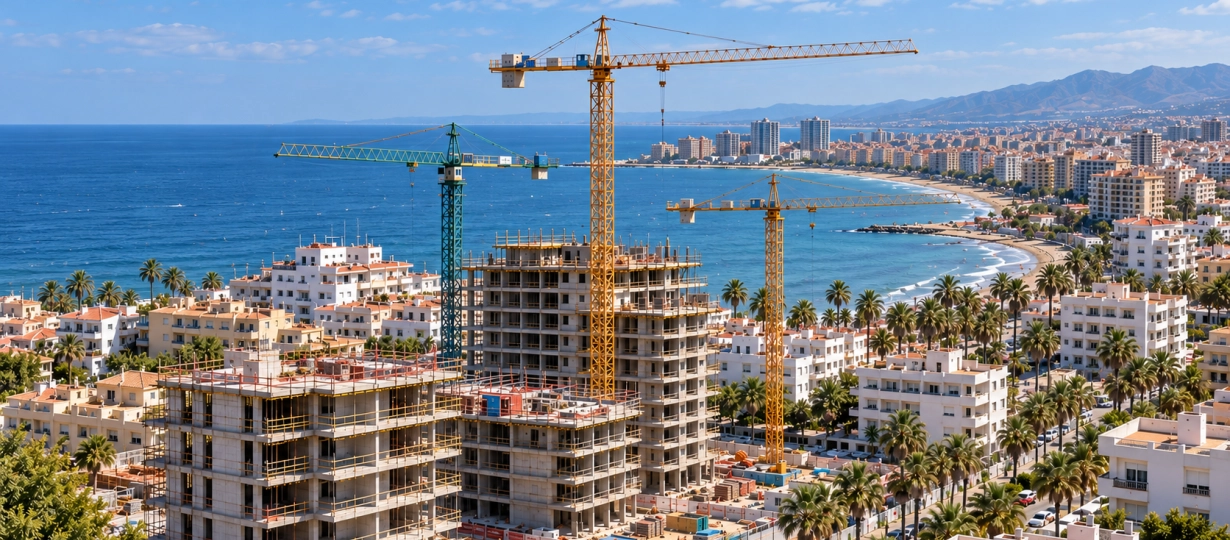
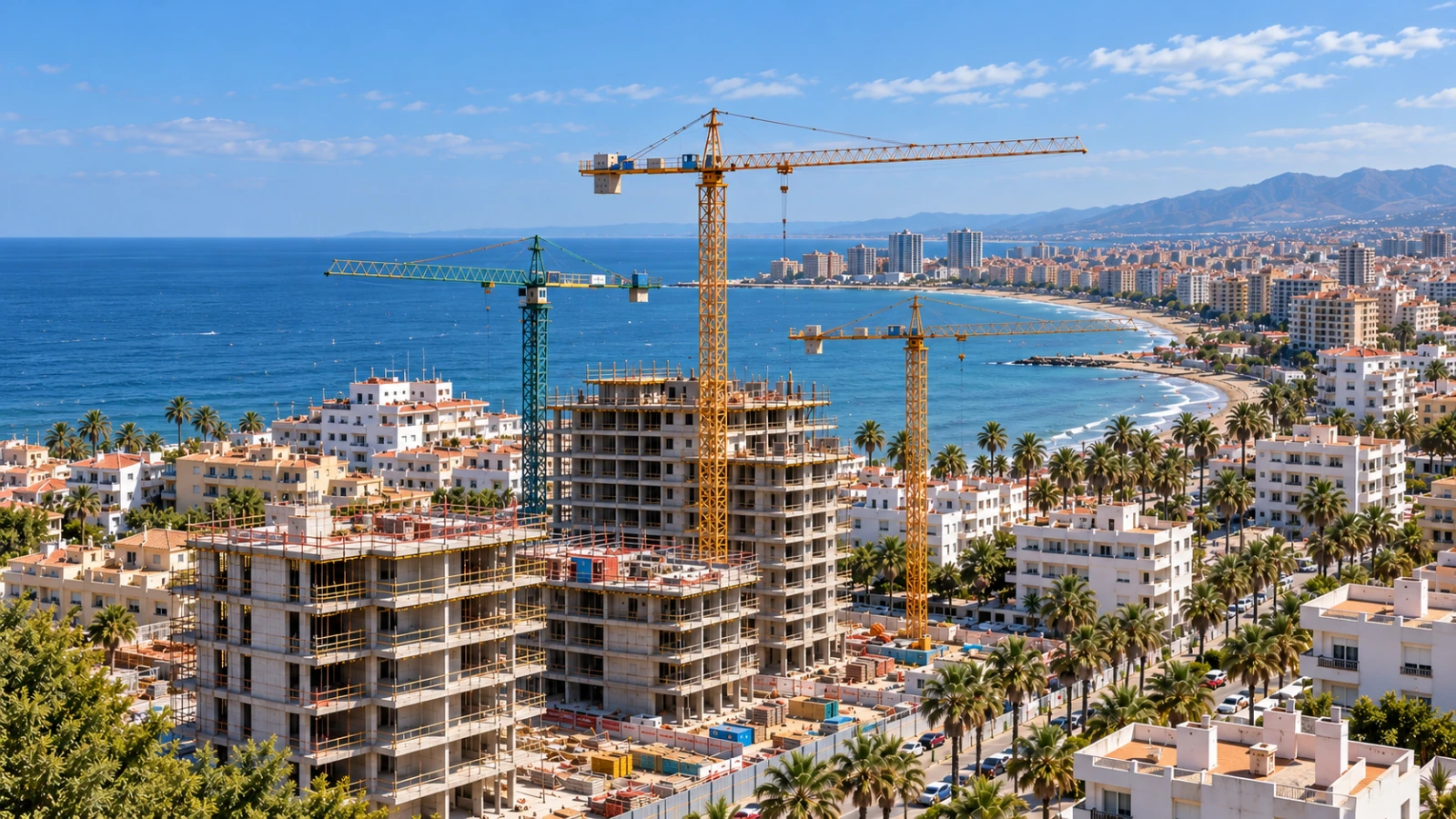
If you haven't been to Torrevieja for a long time, upon arrival you will be surprised: tower cranes stand in almost every district, and construction site fences hang advertising banners with prices "from 160 thousand". The first thought for many is the same: "This has all happened before. This is how the 2008 catastrophe began." Let's figure it out without panic and without rose-colored glasses, based on the numbers.
What is really happening in Torrevieja
The numbers are indeed record-breaking. In the first quarter of 2026, 1,281 homes began construction in Torrevieja, while in the whole of 2025 there were 1,148. That is, the city surpassed the entire previous year's figure in three months. Overall, in the province of Alicante, a record 11,702 houses and apartments were started in the last twelve months.
The engine of this growth is in the south. In Vega Baja, which includes Torrevieja, Orihuela-Costa, and Guardamar, 4,981 homes started in a year, 27% more than at the end of 2025. Overall in the province, in the first quarter of 2026 there were 3,418 starts, 25% more than a year ago. This is the second-best result since the market crash almost twenty years ago.
But not everything grows evenly. The Elche district showed the sharpest decline: only 120 housing units started in the quarter. And by the results of the first half of 2026, the area of new construction in the province was lower than a year ago: 1.16 million m² versus 1.29 million m². Growth is not a smooth wave across the coast. It is concentrated in several municipalities, and Torrevieja is the main one among them. It again topped the list for new housing construction with a share of 12.4% of the entire province's area and 483 buildings.
Why the word "2008" scares
In 2007–2008, Spain built like never before. In two years, 1.27 million houses were built, while now the average volume is about 143 thousand per year. The market was built without regard for real demand, loans were granted almost without checks, and then it collapsed, leaving thousands of unfinished houses behind.
Therefore, today's "boom" in Torrevieja causes a feeling of déjà vu for many, especially those who remember those years personally. The comparison is logical, but let's check it on the merits.
How 2026 differs from 2008
Scale. On a national scale, construction is many times less than at the peak of the last cycle. Now about 2.7 homes start per thousand residents, whereas before the 2008 crisis it was almost 20. Even the record numbers for Torrevieja are incomparable to what was happening across the country during the last boom.
Deficit instead of surplus. The main problem of today's market is a housing shortage. In 2025, about 136 thousand building permits were issued. This is the highest figure since 2008, but 226 thousand new households were formed. According to CaixaBank Research forecasts, Spain's housing deficit will continue to grow and exceed 900 thousand units by 2029. When demand structurally exceeds supply, prices rise, and construction itself is not a bubble.
Loans. Before 2008, the bubble inflated on cheap money. Banks issued mortgages for 100% or more of the cost, almost without checking solvency. Now the picture is different: restrictions are strict. The Bank of Spain talks about moderate price overvaluation but not a credit bubble.
Buyer. Demand on the coast is largely international. In the first quarter of 2026, about 44% of transactions in Alicante province were by foreigners, the highest share in Spain. In the second quarter, this figure reached 46.43%, according to one agency. These are buyers with their own money, independent of local wages and Spanish banks.
Where the real risks are
That 2026 does not repeat 2008 does not mean there are no risks. They are just different.
Concentration. When one area accounts for most of the new builds in the province, there is a risk of local overheating. Experts from the Association of Valuers (AEV) note that there is no overall bubble in the country but warn of "localized tensions," and the risk may be regional rather than nationwide. The more competing projects in one area, the harder it is for each to sell.
Market saturation. Industry experts already warn of possible saturation after such rapid growth. Also, activity slightly decreased at the end of March and early April amid international economic uncertainty. This is not a trend yet but a signal to watch.
Cost of money. Mortgages are becoming more expensive: the 12-month Euribor rose from 2.245% at the start of the year to 2.855% by July, according to the Association of Mortgage Banks. This is noticeable for buyers with loans.
Deadlines and quality. The more projects under construction simultaneously, the higher the load on contractors and the more frequent delays in delivery. During the boom years, it was the fly-by-night developers who caused the main problems for buyers.
Price growth is not endless. The price per square meter in Torrevieja, according to one local company, ranges from 1,500 euros away from the sea to 2,800 euros near the beach. For Costa Blanca, this is still an affordable segment, and it attracts those deterred by prices in other regions. But the room for growth is shrinking, especially in first-line new builds.
What buyers of new homes in Torrevieja should consider
If you are considering an apartment or villa in a building under construction, go through this checklist.
- Developer. How many projects have they completed and on time? Ask for addresses and visit finished houses; do not rely solely on renderings. If you need an independent check, we can help gather information about the developer and project before you make the first payment.
- Bank guarantee. By law, all buyer advances when purchasing off-plan housing must be protected by a bank guarantee or insurance. Request the document before the first payment.
- Permits. Check the construction license and make sure the land belongs to the developer free of encumbrances. Through a notary or independent lawyer.
- Stage. A project on paper, foundation laid, or nearly finished house carries different risk levels. The earlier the stage, the bigger the discount and the greater the uncertainty.
- Comparison with resale. Calculate the price per m² of the new build and a similar apartment on the secondary market nearby. If the gap is excessive, ask what you are paying for.
- Exit. Assess how you will sell or rent the property. In an area where several hundred similar apartments are delivered simultaneously, this may take more time.
- Rental. Short-term rental rules on the coast are changing, so factor in a long-term scenario.
What this means for the city
One less talked about consequence of the construction boom: it solves part of the affordability problem. In Torrevieja, 822 social housing apartments under the Plan Vive program are already starting construction; they should appear by 2028. This means the city not only sells housing to foreigners but also grows the housing stock for those who live and work here.
Verdict: not a bubble, but not a free ride either
Torrevieja in 2026 does not repeat 2008: the market is not financed without checks, the housing deficit in the country is huge, and buyers are largely wealthy and international. But the record construction pace in one city means increased competition among projects and higher demands on choice. In such conditions, those who verify the developer, documents, and deadlines win, and those who buy based on advertising pictures lose.
The market does not promise easy money but does not herald disaster either. It requires buyers' attention and a good lawyer.
If you are considering new builds in Torrevieja or other Costa Blanca areas and want to compare projects without haste, write to us. We will select options based on your budget and goal (for living, renting, or investment), show the difference between new builds and resale on specific examples, and check documents before signing a contract. The decision is yours, but it's better to make it with numbers and verified facts in hand.




Comments