Mérida in August – Through Ancient Rome with Zuky
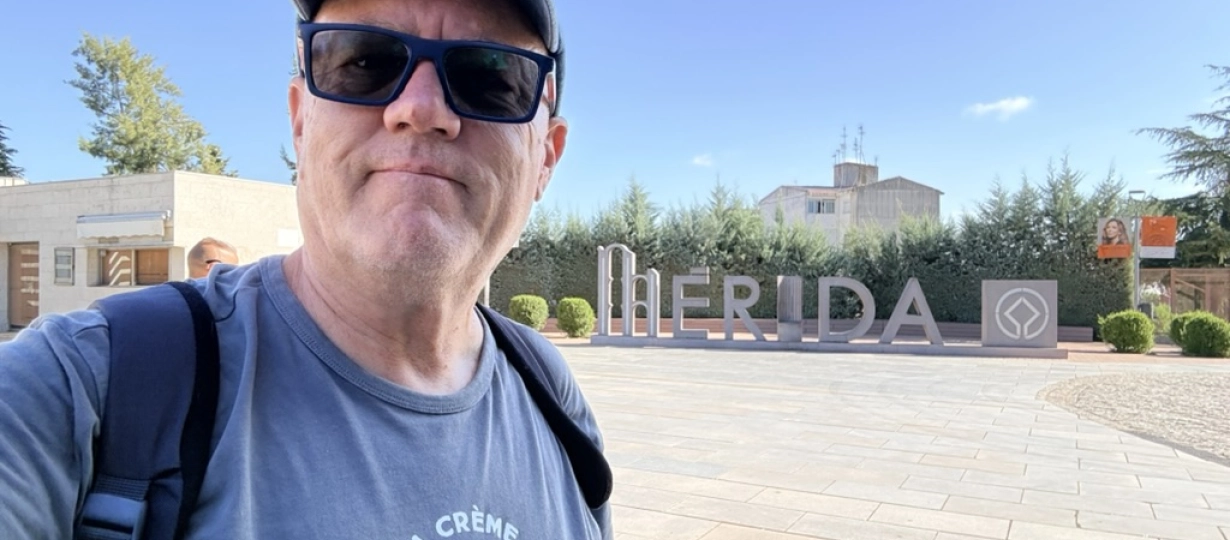
Come on, let’s go early. It is the fifth of August, and anyone who sleeps away the morning in Extremadura has already lost the day. At eight o’clock, the air in the narrow streets is still cool, bright and dry like freshly ironed linen, and only the sharpness of the shadows gives you an idea of what will settle over this city by two in the afternoon.
Zuky walks ahead of me. He knows the ritual. He pulls slightly on the lead, the way dogs do when they are not trying to get anywhere in particular, but simply want to keep moving. I let him. You travel better following a dog than following a guidebook.
The Streets
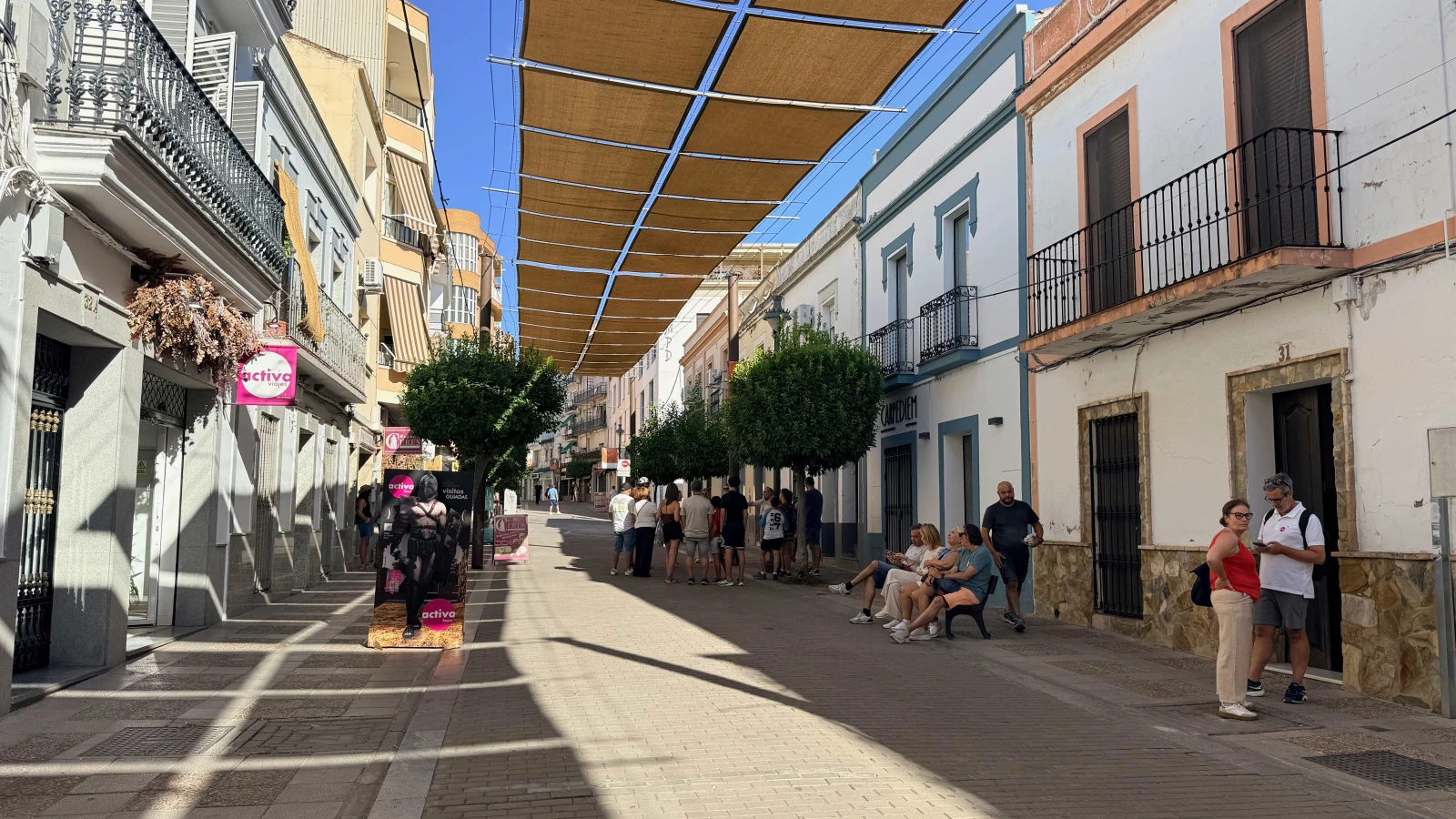
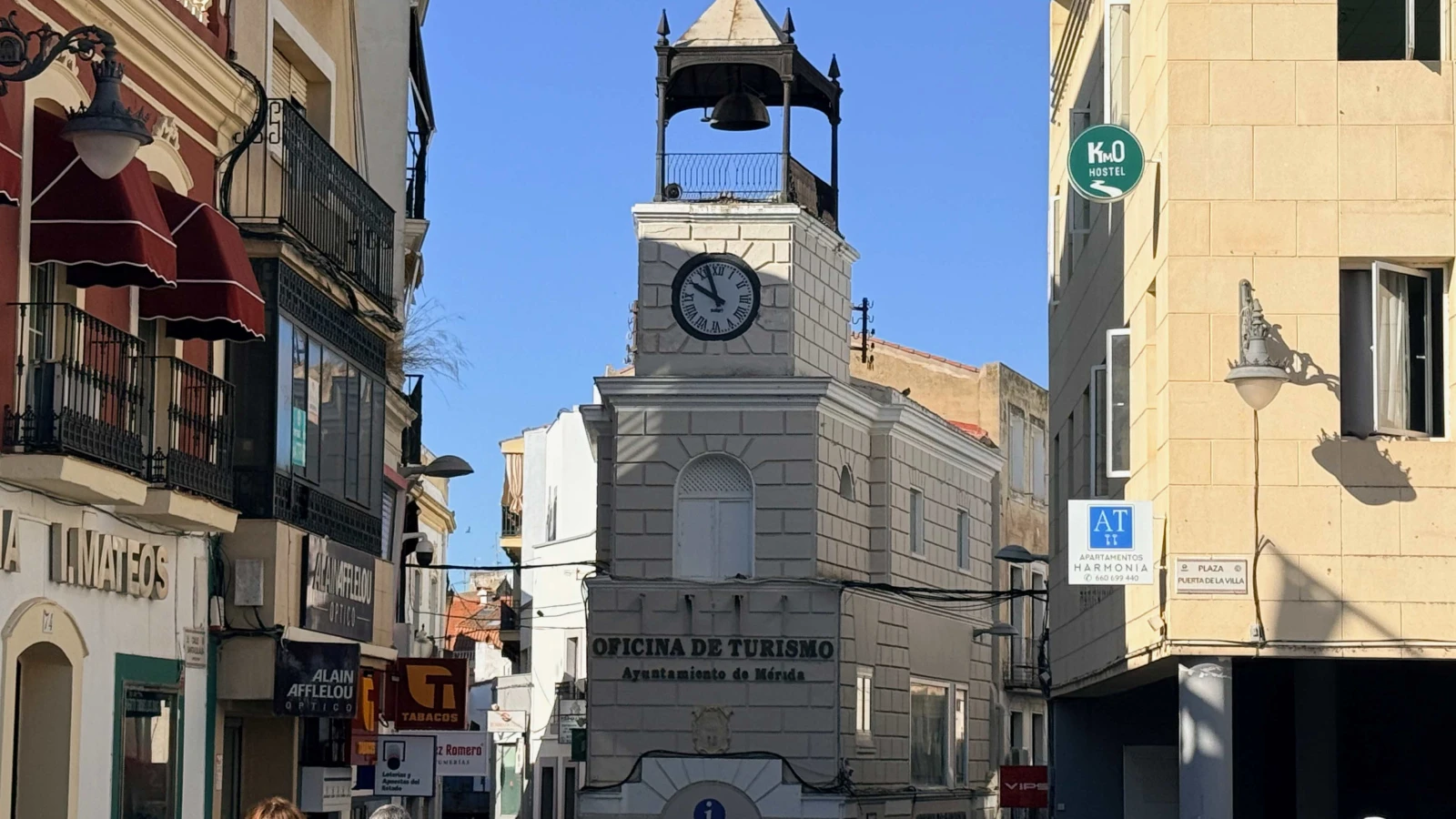
Mérida’s old town is small, and that is part of its charm. You do not really get lost here; you merely lose yourself for a little while, and that is something entirely different. Whitewashed walls the sun has not yet reached. A balcony with geraniums, already half-thirsty and still blooming. Somewhere, a shutter rattles upwards, someone places a crate outside a doorway, and from a bar comes the smell of coffee and hot oil.
And then, right in the middle of this everyday life, on a corner where you expect nothing at all: columns. A Roman temple, Corinthian capitals, granite two thousand years old – and inside it, like a cuckoo’s egg, a Renaissance palace built into the ancient structure by a nobleman in the sixteenth century because the columns happened to make rather convenient walls. The Temple of Diana. It has been called that for centuries, although it probably never belonged to Diana at all; most likely, it was dedicated to the imperial cult. But names are more stubborn than truths.
That is what holds my attention in Mérida: antiquity is not fenced off somewhere in a green archaeological park. It stands between ordinary houses. A child pushes his bicycle past a triumphal arch without even looking up. The Arch of Trajan, thirteen metres high, bare and powerful, its marble cladding long since stripped away – today simply a passage between two streets, something you walk through on your way to the bakery in the morning.
Zuky lifts his leg against a stone older than Christianity. I say nothing. I suspect the Romans would not have said much about it either.
What Happened Here
Because you should know where we are walking.
In 25 BC, Augustus sent his retired legionaries here, men from Legio V Alaudae and Legio X Gemina, and the new settlement was given the name Emerita Augusta – the city of Augustus’s veterans. Over the centuries, the name was worn smooth like a pebble in a river until it became today’s Mérida.
It did not remain some soldiers’ backwater. Emerita Augusta became the capital of the province of Lusitania and one of the greatest cities of Roman Hispania: a theatre, an amphitheatre, a circus for thirty thousand spectators, aqueducts, baths, and a bridge across the Guadiana that would outlast almost everything.
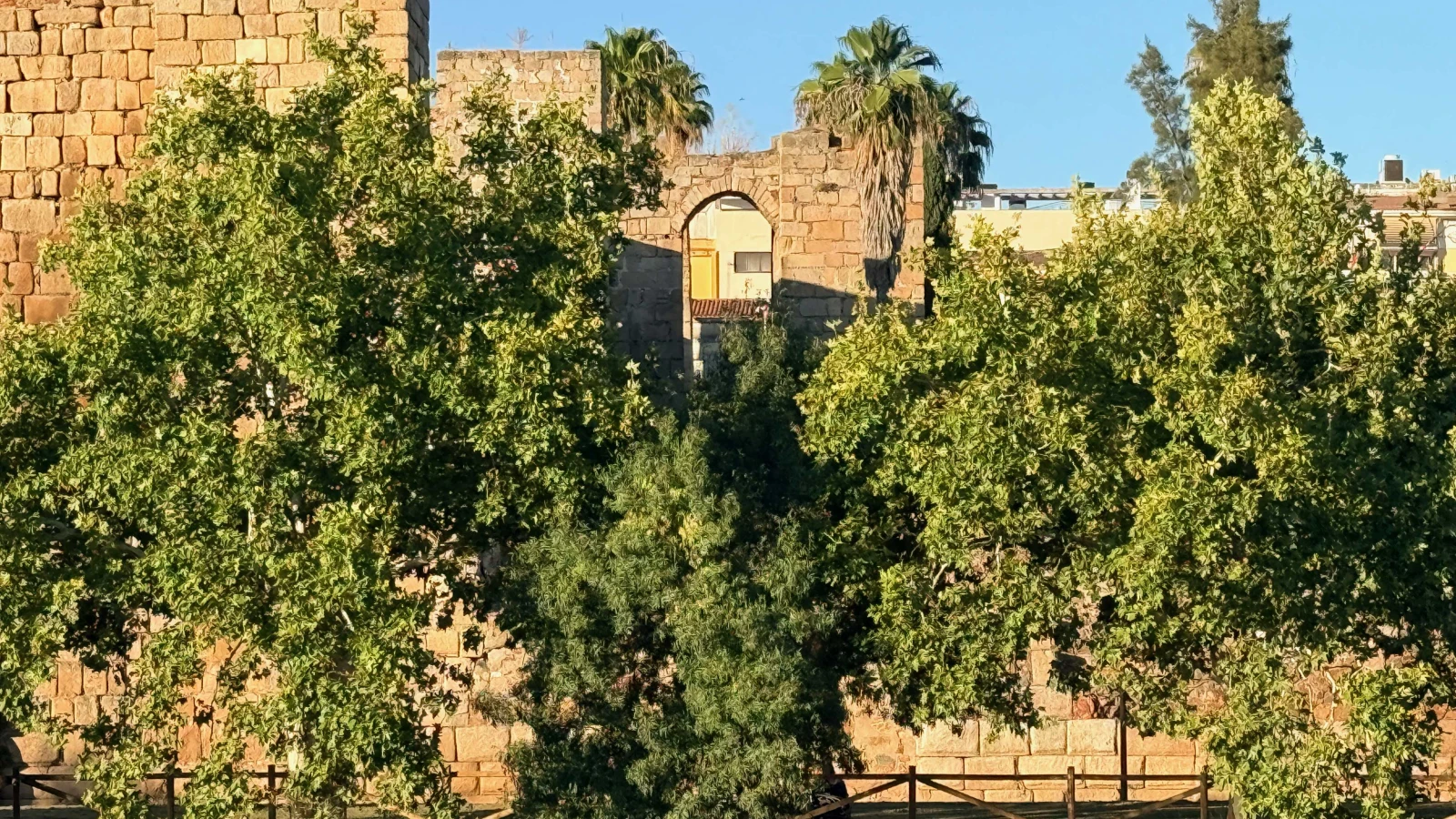
Then came the Visigoths, for whom Mérida became an important religious and secular centre. The Arabs arrived in 713. In 835, Abd ar-Rahman II built the Alcazaba beside the river, the oldest surviving Muslim fortress on the Iberian Peninsula – and, as was customary at the time, he built it partly from Roman stones.
In 1230, Alfonso IX of León took the city.
And after that: silence.
Centuries followed in which Mérida became a provincial country town, where farmers built their stables between ancient walls and reused marble blocks as doorsteps. There is something strangely comforting in the thought that this very poverty helped preserve so much. Where nothing new is built, little of the old needs to be demolished.
The Theatre
We walk up towards the Roman Theatre, and I need to explain something before you see it: until the twentieth century, almost none of it was visible.
There was simply a hill with seven stone humps, which local people called Las Siete Sillas – the Seven Chairs. Legend had it that seven kings had once sat there, discussing the fate of the city.
Only from 1910 onwards was the hill excavated. And beneath it lay – intact, in all its audacity – the great stage wall with its two tiers of columns, its statues and its marble.
Performances returned in 1933. The International Festival of Classical Theatre is one of Europe’s oldest theatre festivals, and it takes place right now, during these summer weeks: Medea, Antigone, Plautus, performed beneath the open sky in a space built for exactly that purpose.
If you come here in summer, go in the evening. The stone gives back the heat of the day until midnight, and above the stage wall the stars stand almost exactly where they stood in 15 BC.
Zuky is not allowed inside. That is how it is with monuments. He waits in the shade with someone I know, beside a bowl of water, dignified and offended at the same time in the way only a dog can be.
The Bridge and the River
But the most beautiful thing is not the theatre.
The most beautiful thing is the river.
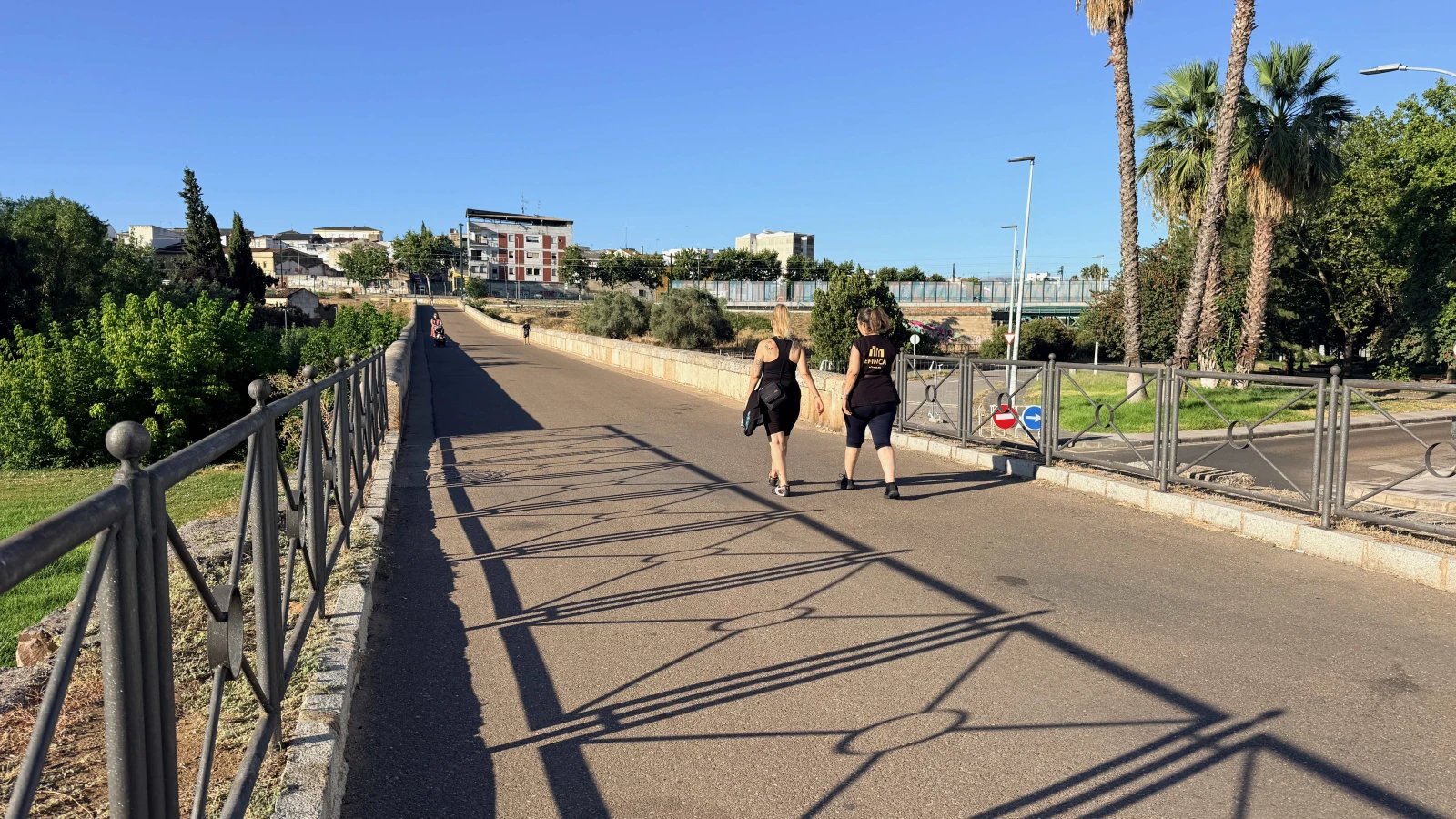
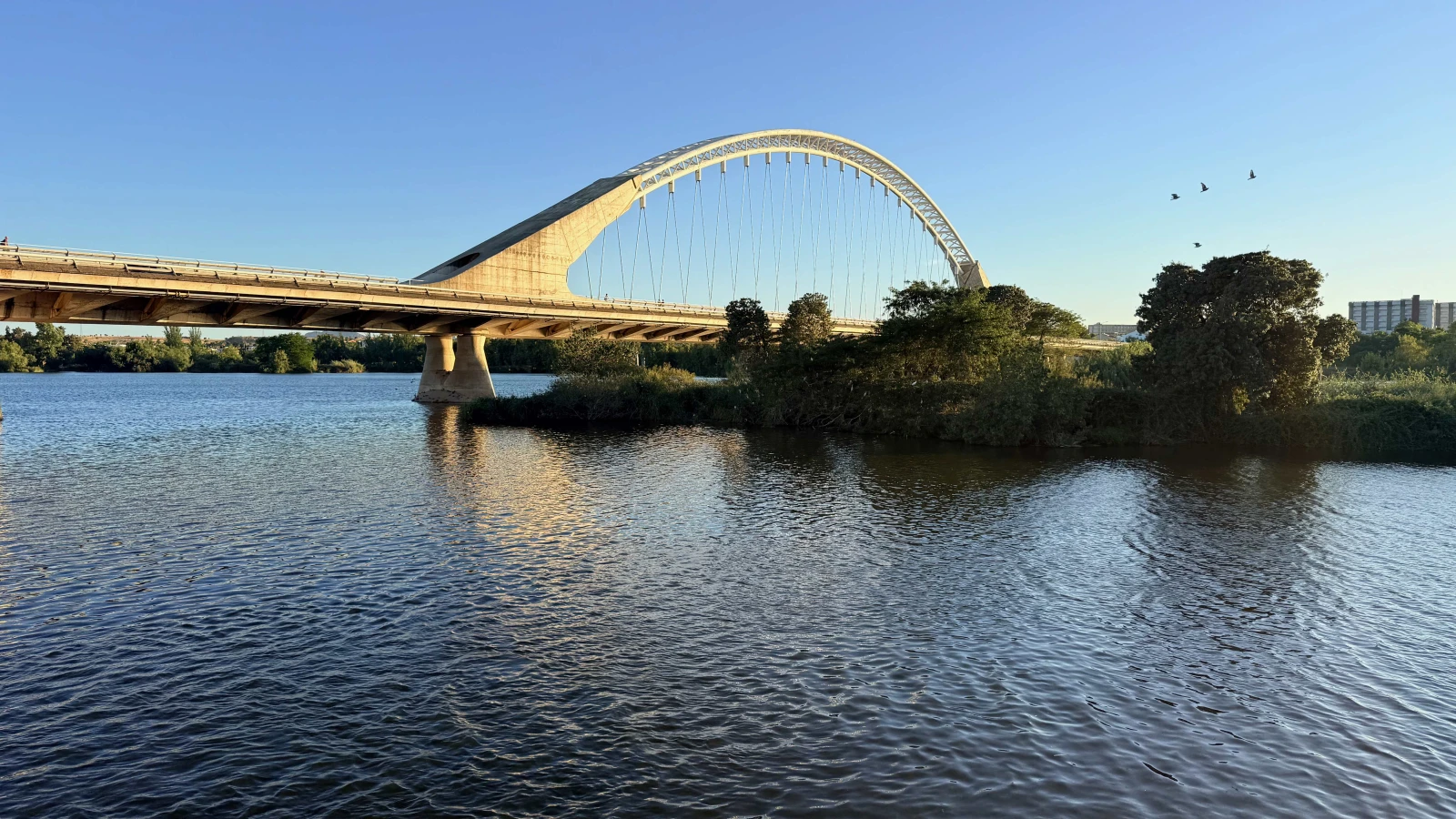
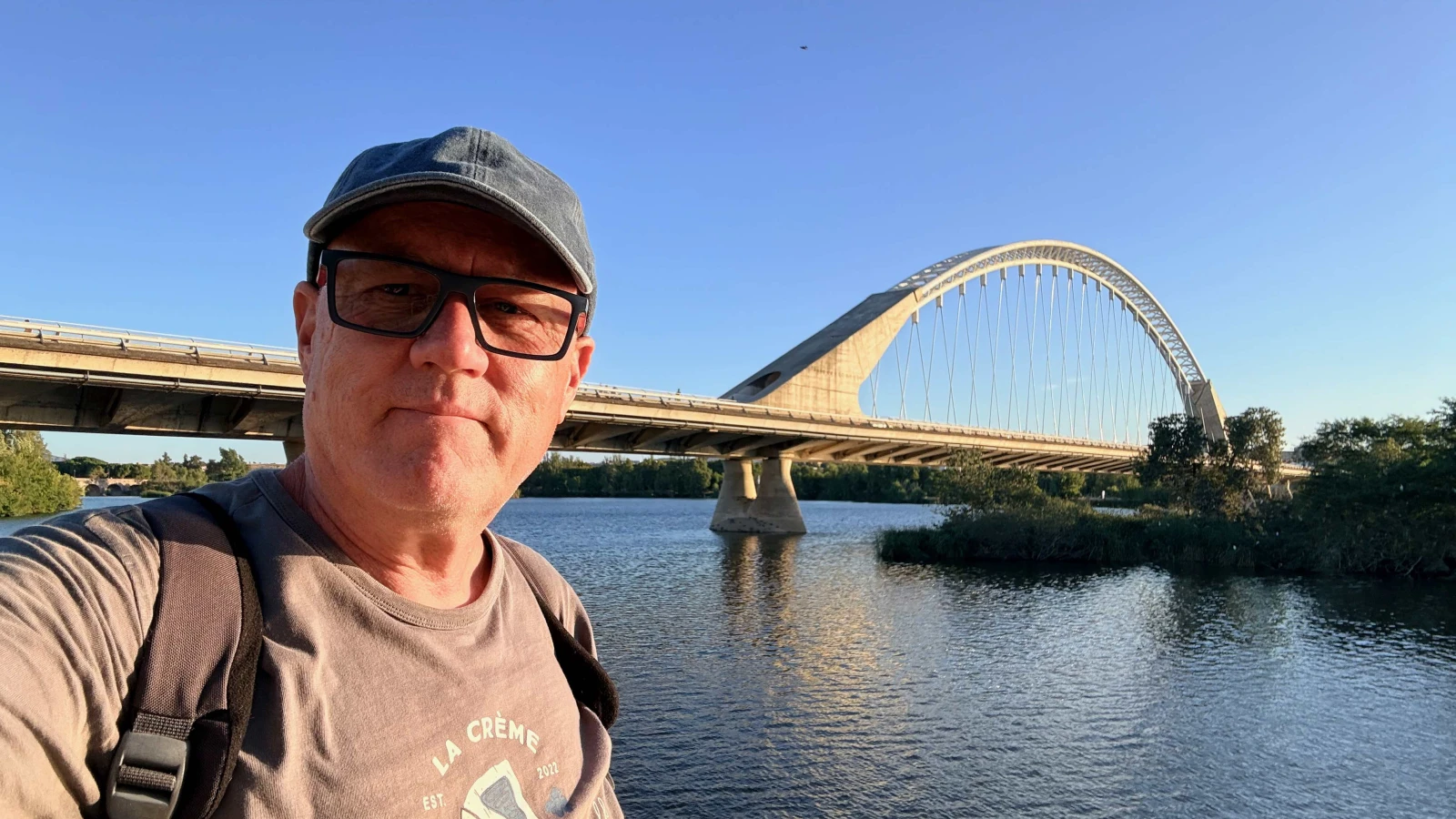
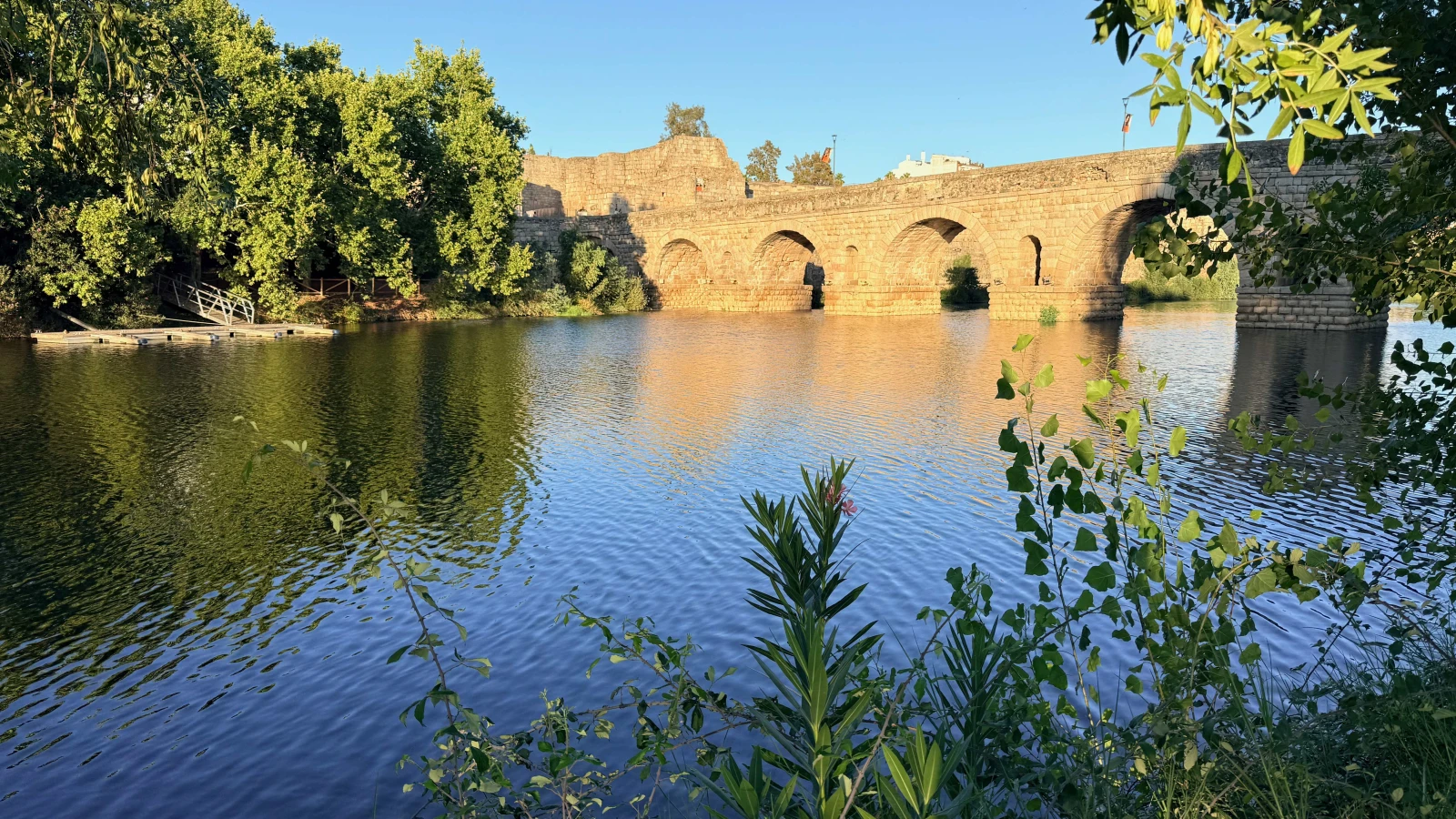
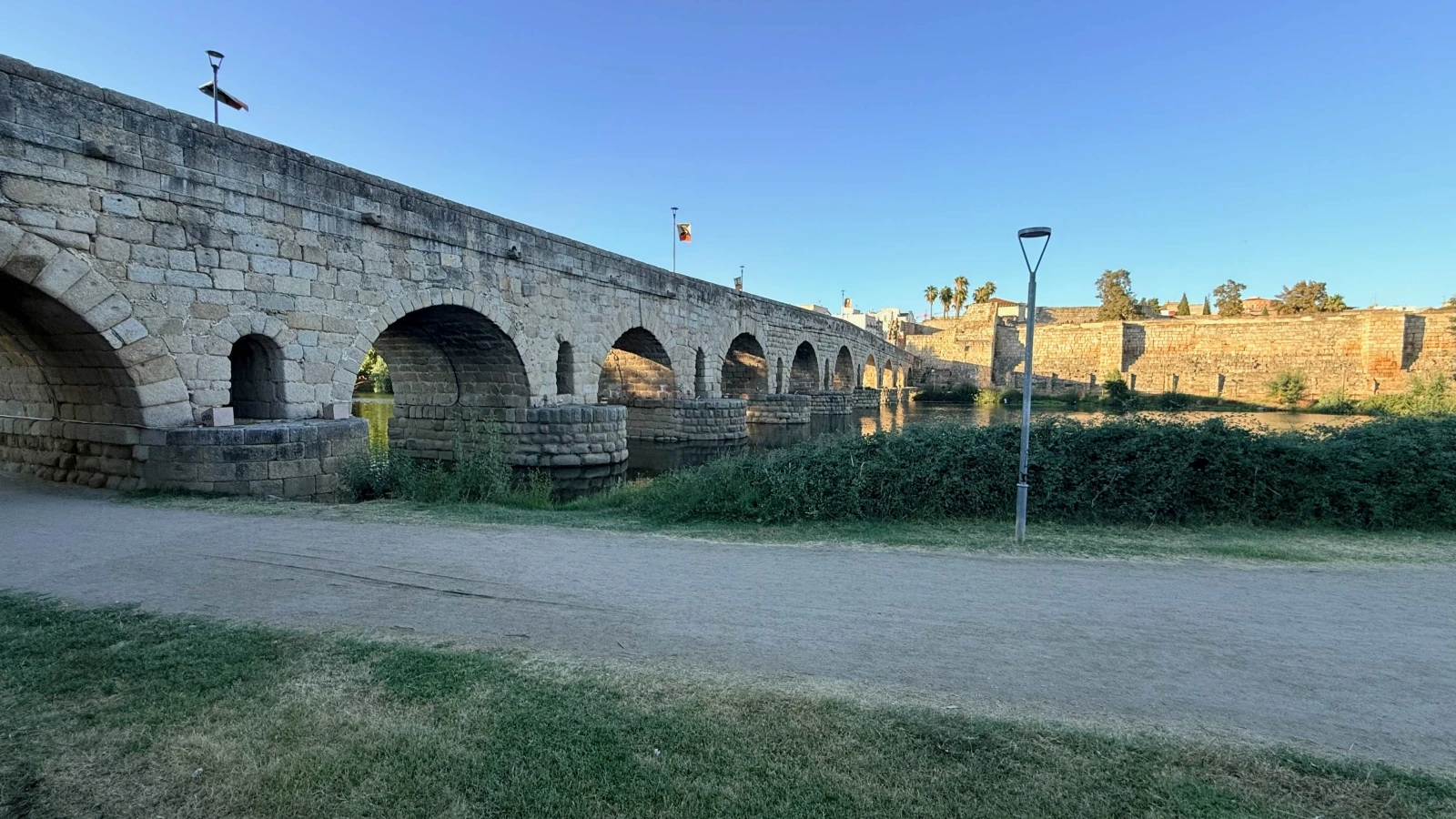
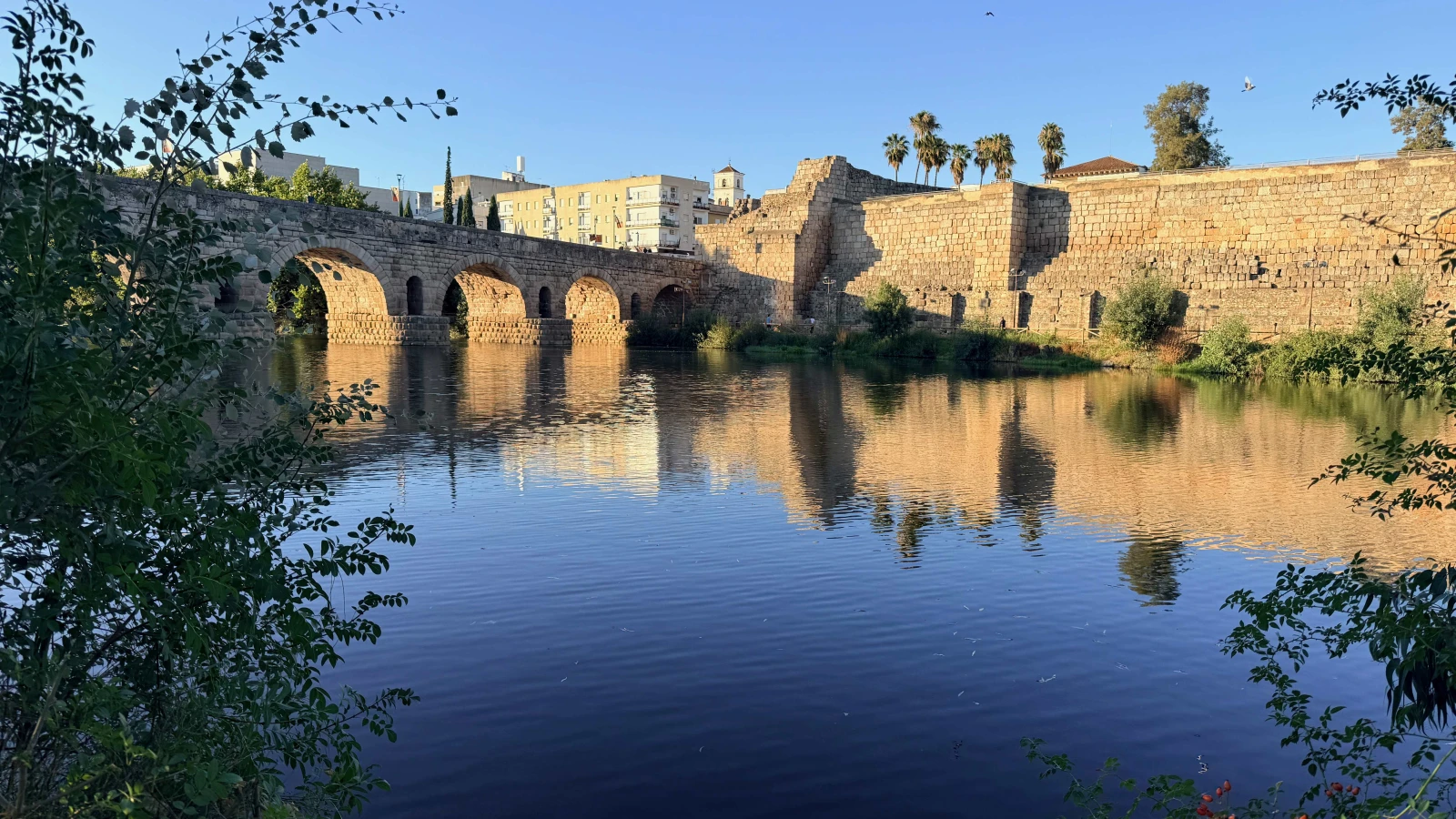
The Roman Bridge is almost eight hundred metres long, with sixty arches – the longest bridge Rome built in Hispania. For two thousand years it carried the city’s traffic. Since 1991, it has finally been allowed to rest, because nearby Santiago Calatrava’s Lusitania Bridge now spans the water: white, sinewy, a single great arch that looks almost like the drawing of an arch.
Two bridges, two thousand years apart, both built to perform exactly the same task.
You can look at them for a long time. You will not become any wiser, only calmer.
And below them, between the two bridges, lies the park.
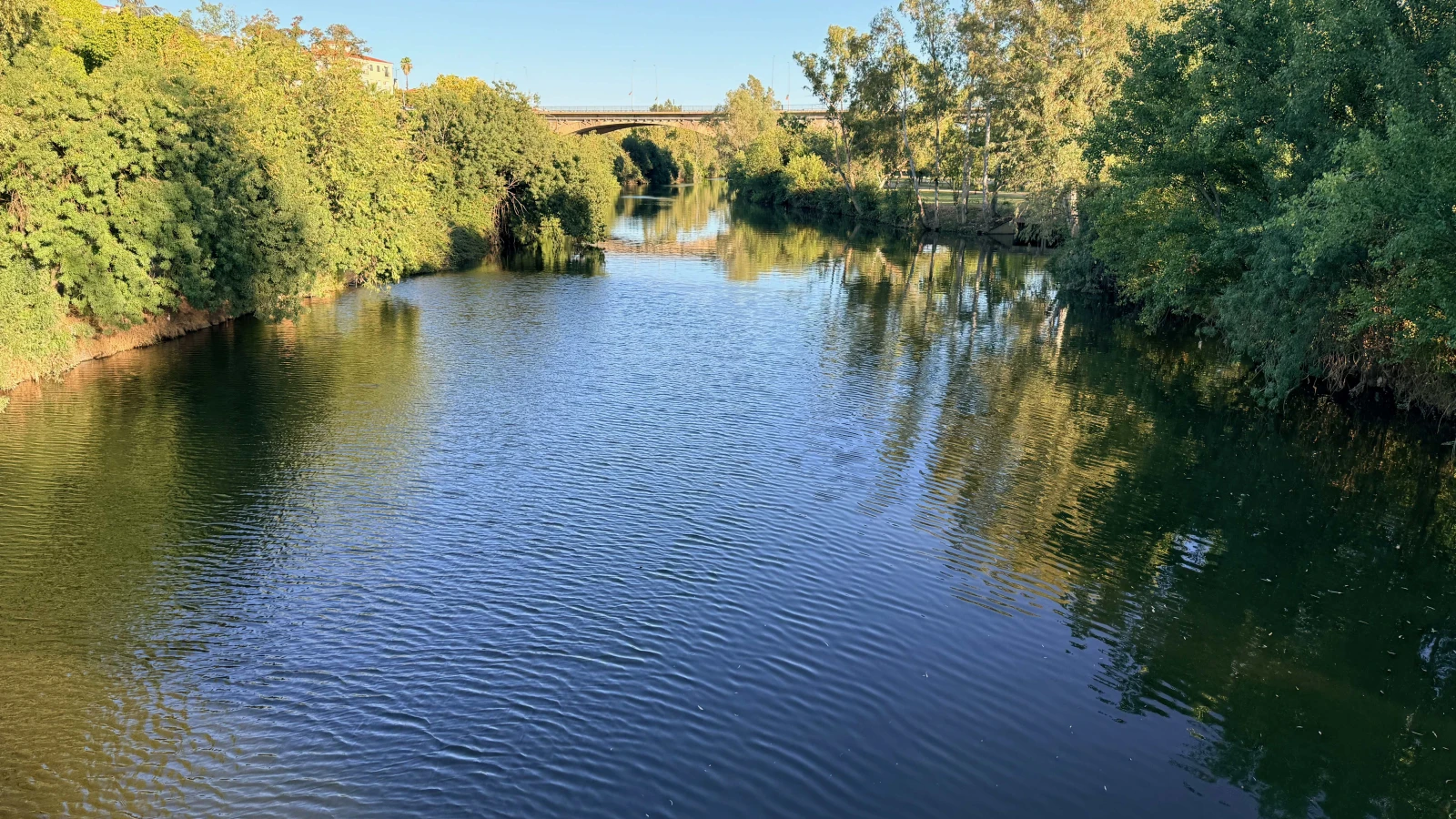
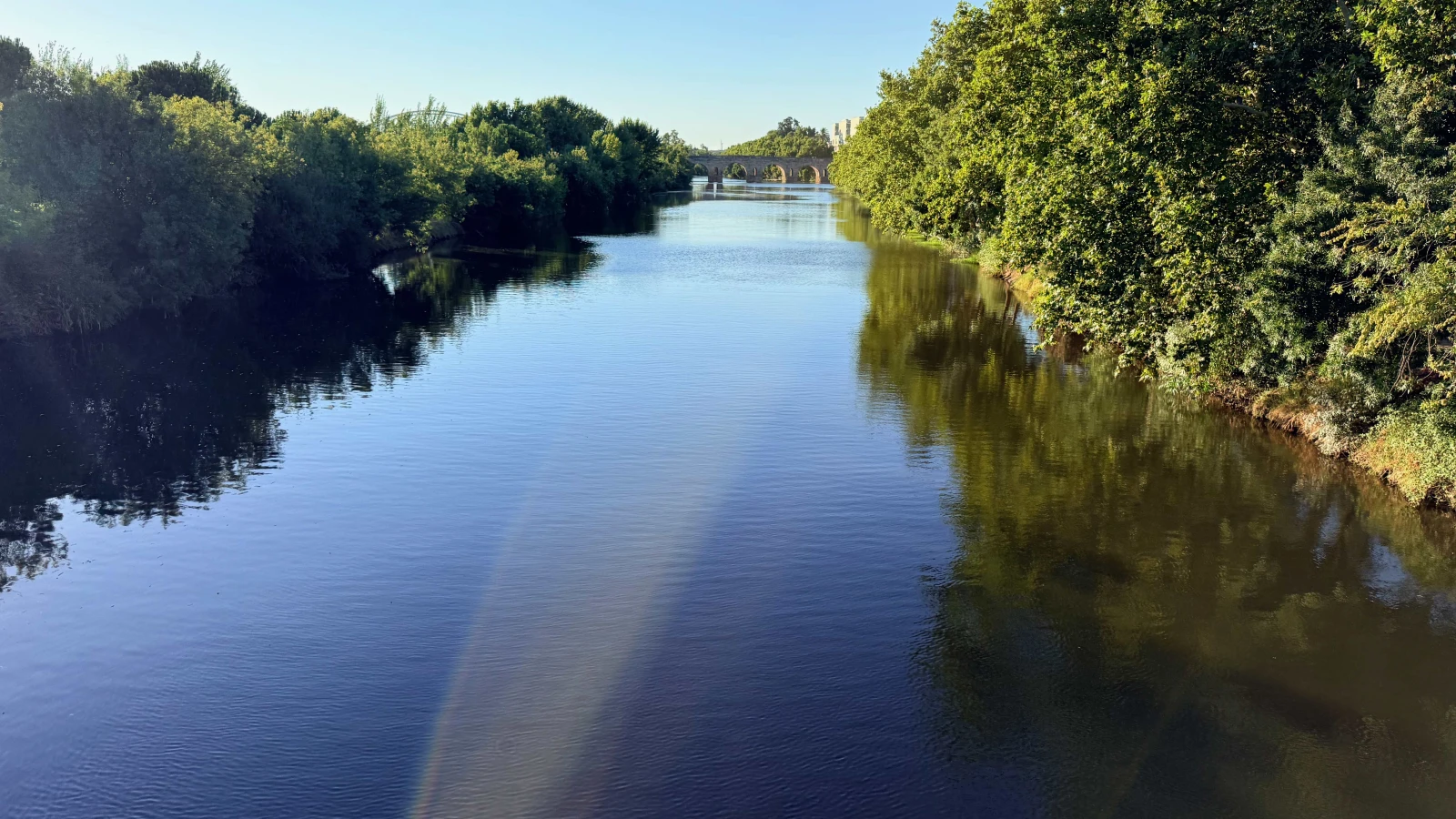
I do not know whether the people of Mérida themselves fully realise what they have here. The Guadiana is dammed at this point, broad, slow and green, and along its banks runs a ribbon of poplars, eucalyptus trees, reeds and trimmed grass stretching for kilometres.
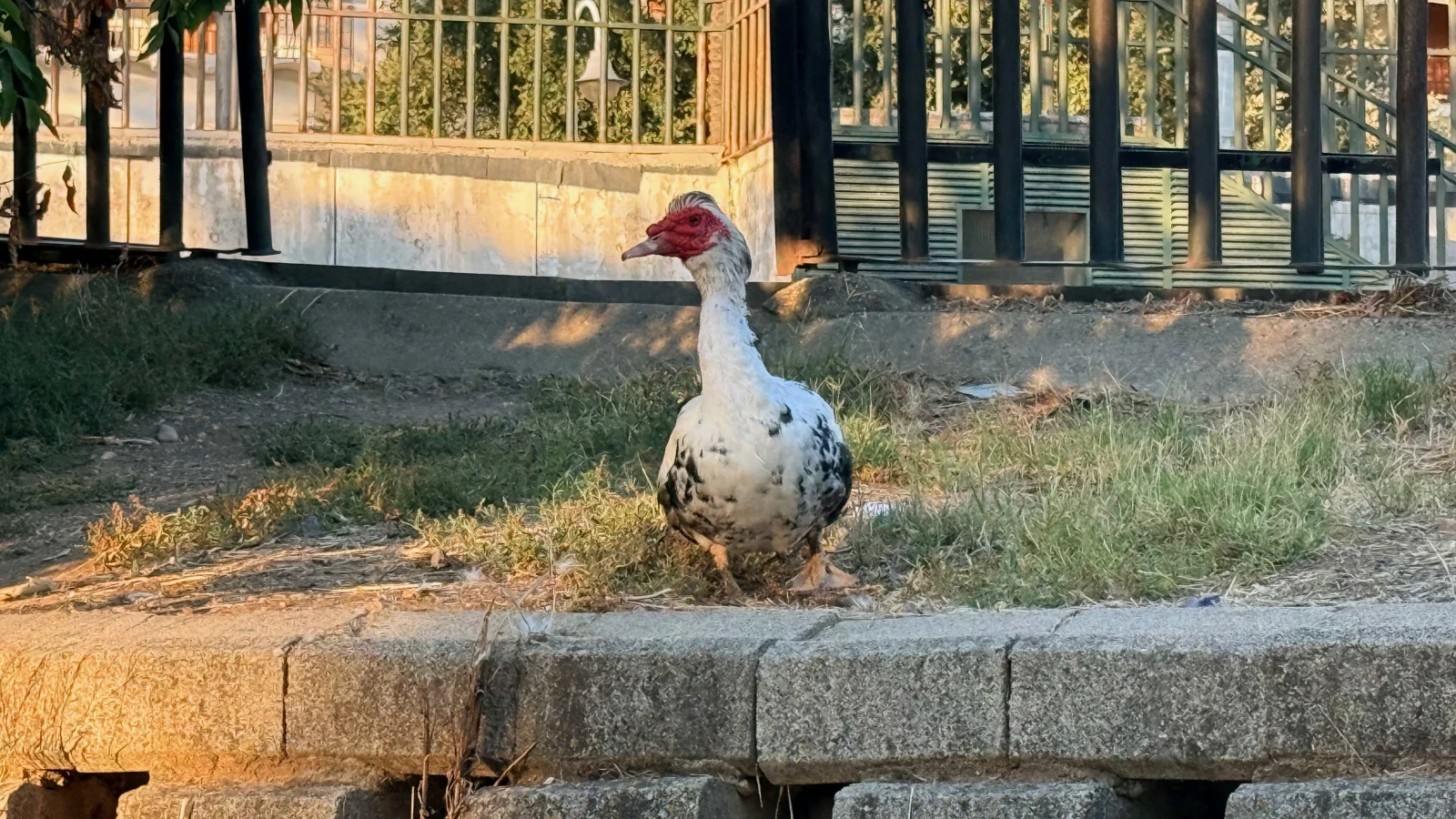
Paths where you can walk without meeting a car. Benches in the shade. Ducks, coots, and, if you stay quiet, a grey heron standing on a concrete ledge like a man waiting for someone who will never arrive. On the islands in the river, willows grow right down into the mud.
Here I give Zuky more freedom. He drinks at the water’s edge, picks up the scents of cats and fishermen and other dogs, and rolls around in the grass because grass in Extremadura in August is a luxury he knows how to appreciate.
We walk as far as the Alcazaba and look up from below at the Moorish wall rising directly above the water. Inside there is a cistern you can descend into, and at the very bottom lies cool, black water filtering through the rock from the Guadiana.
Nine hundred years old and still wet.
If you are here on a hot day, that is the moment you will remember.
The Storks and the Miracles
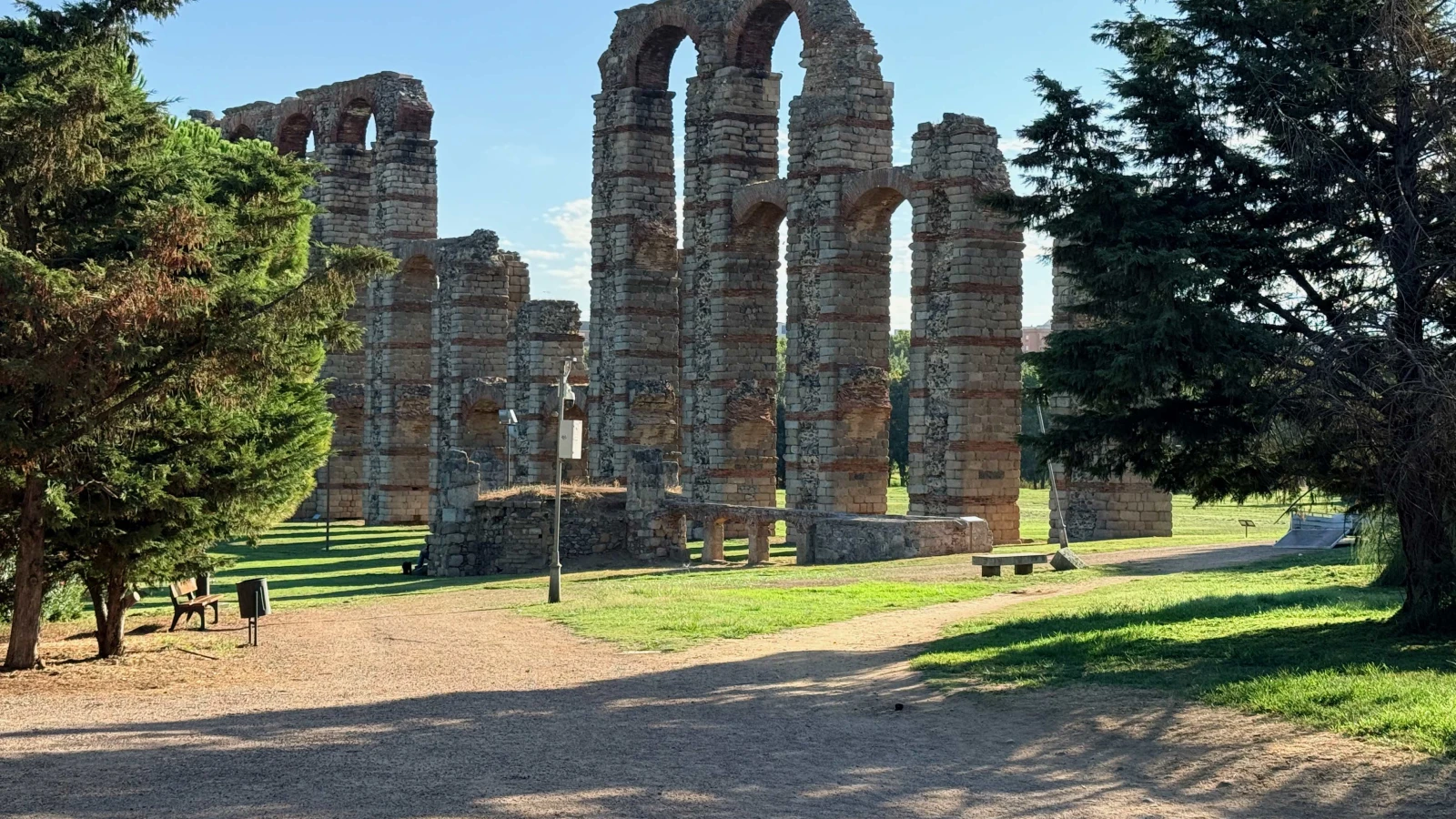
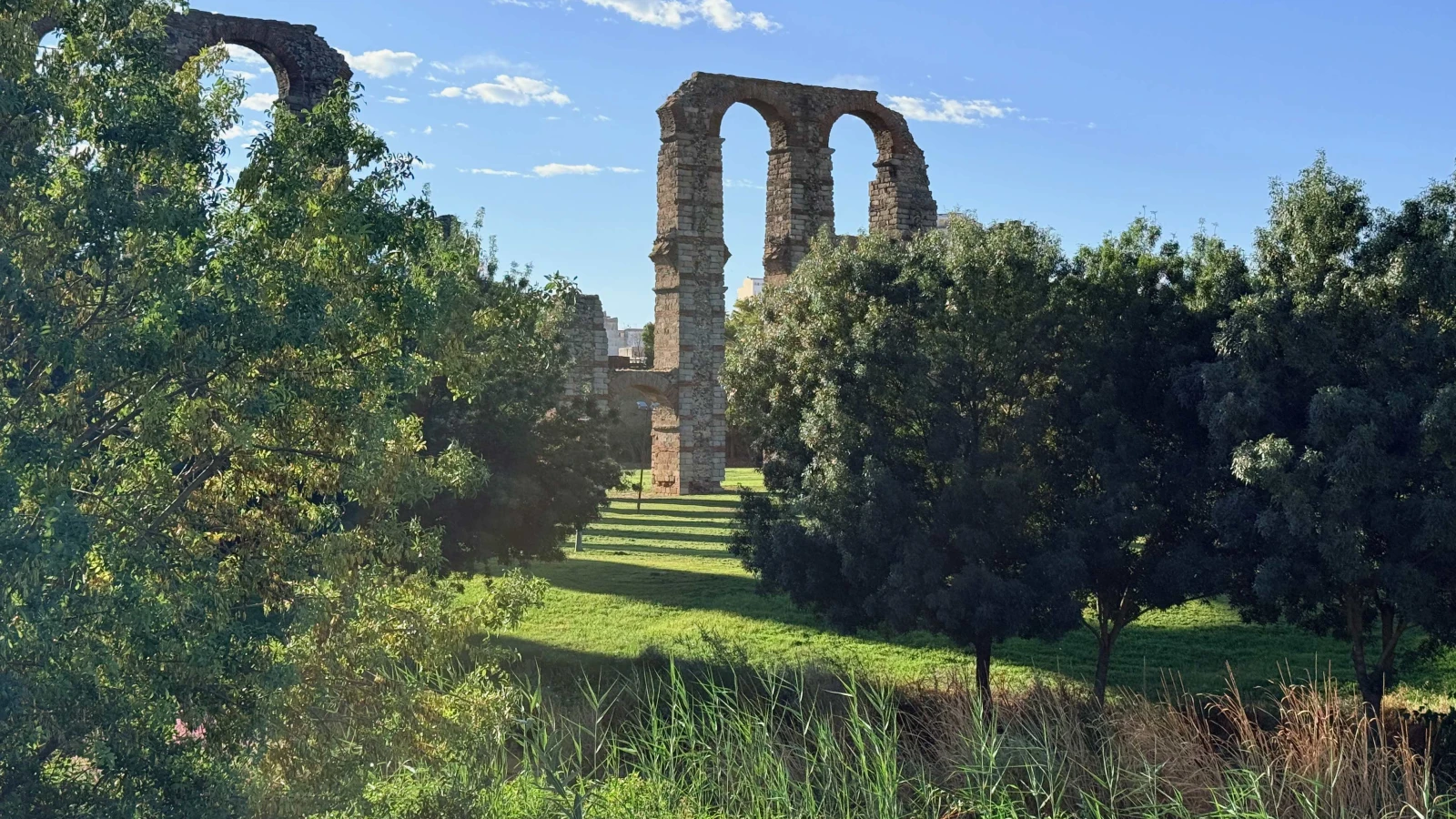
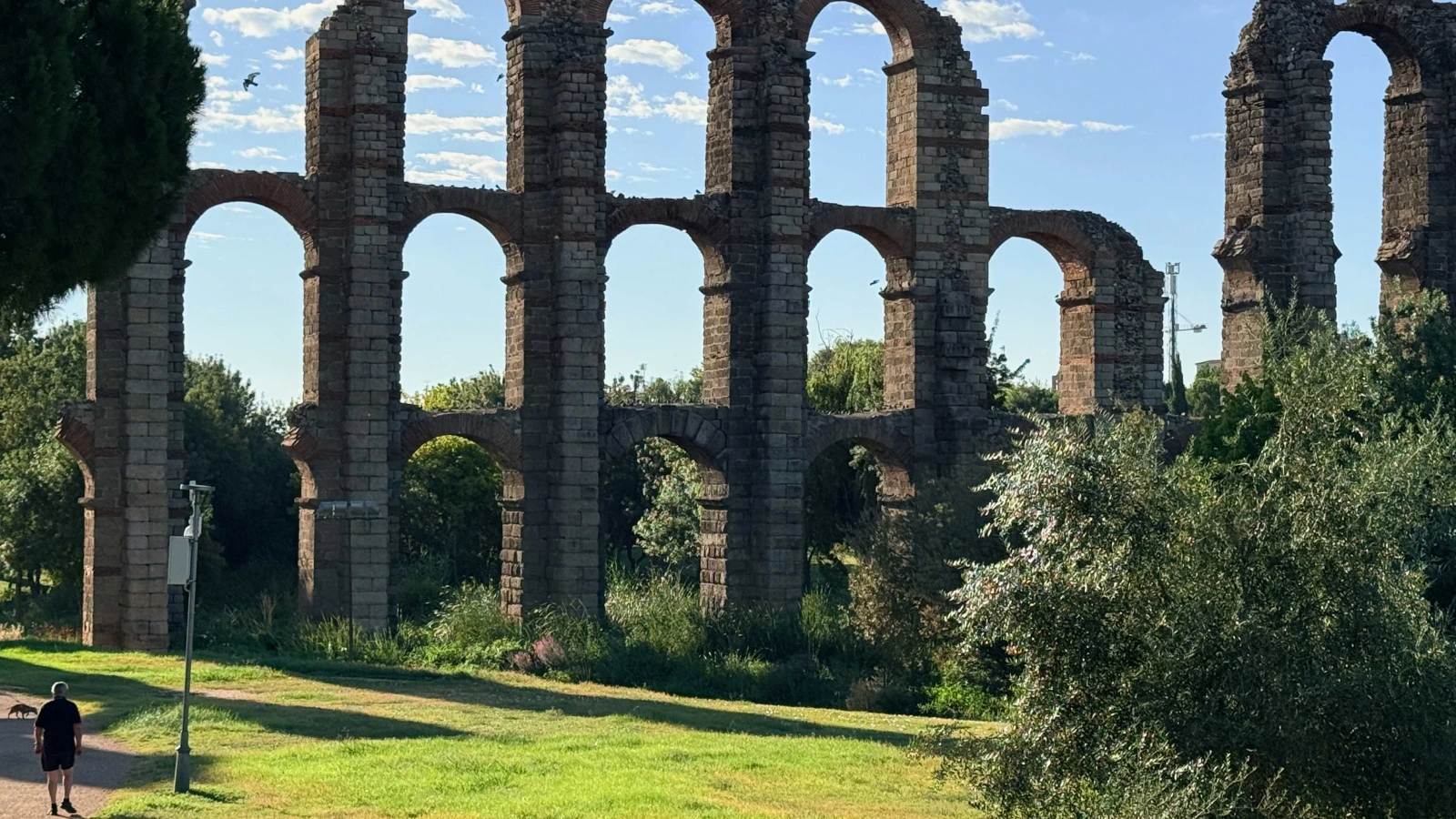
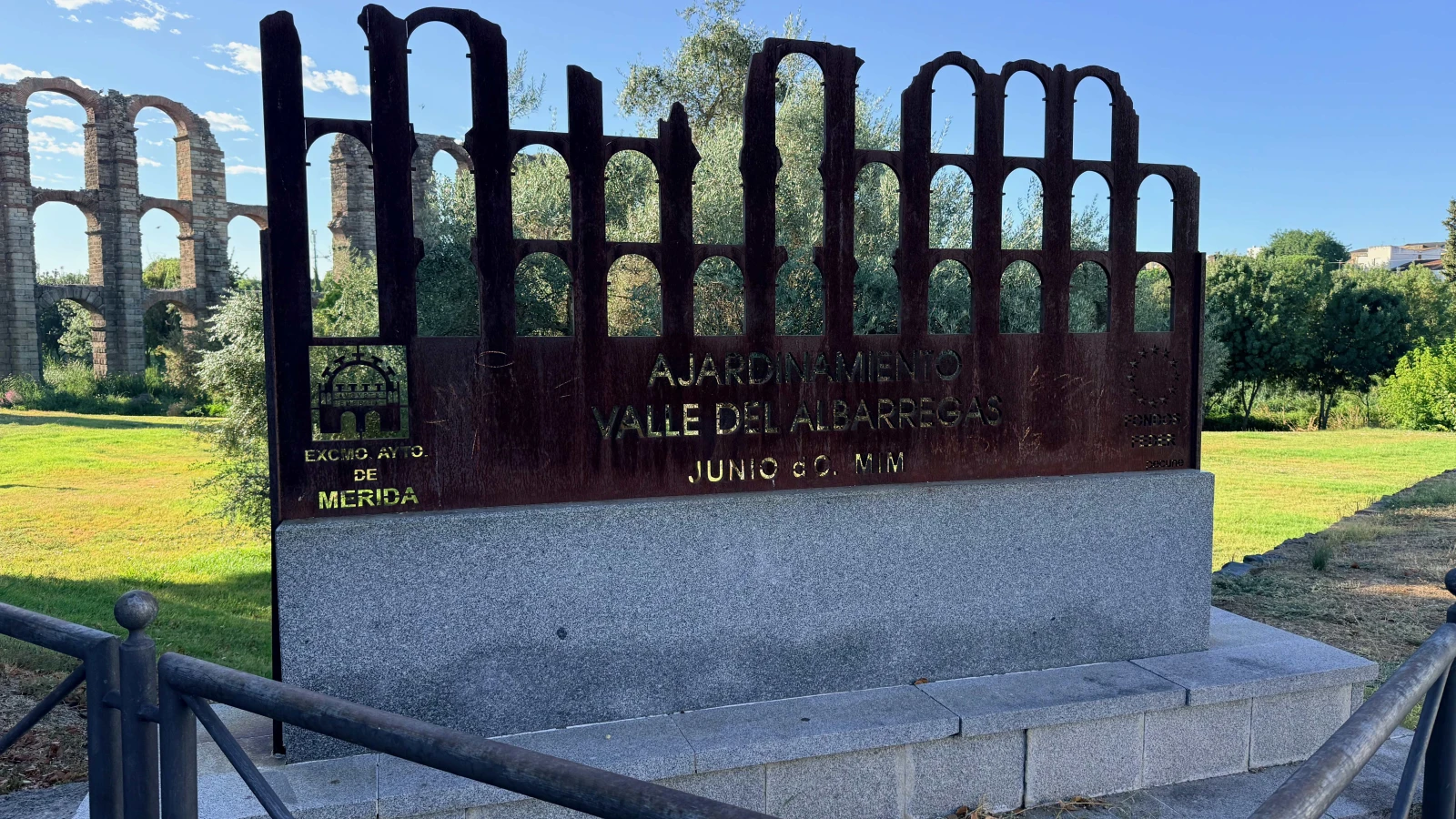
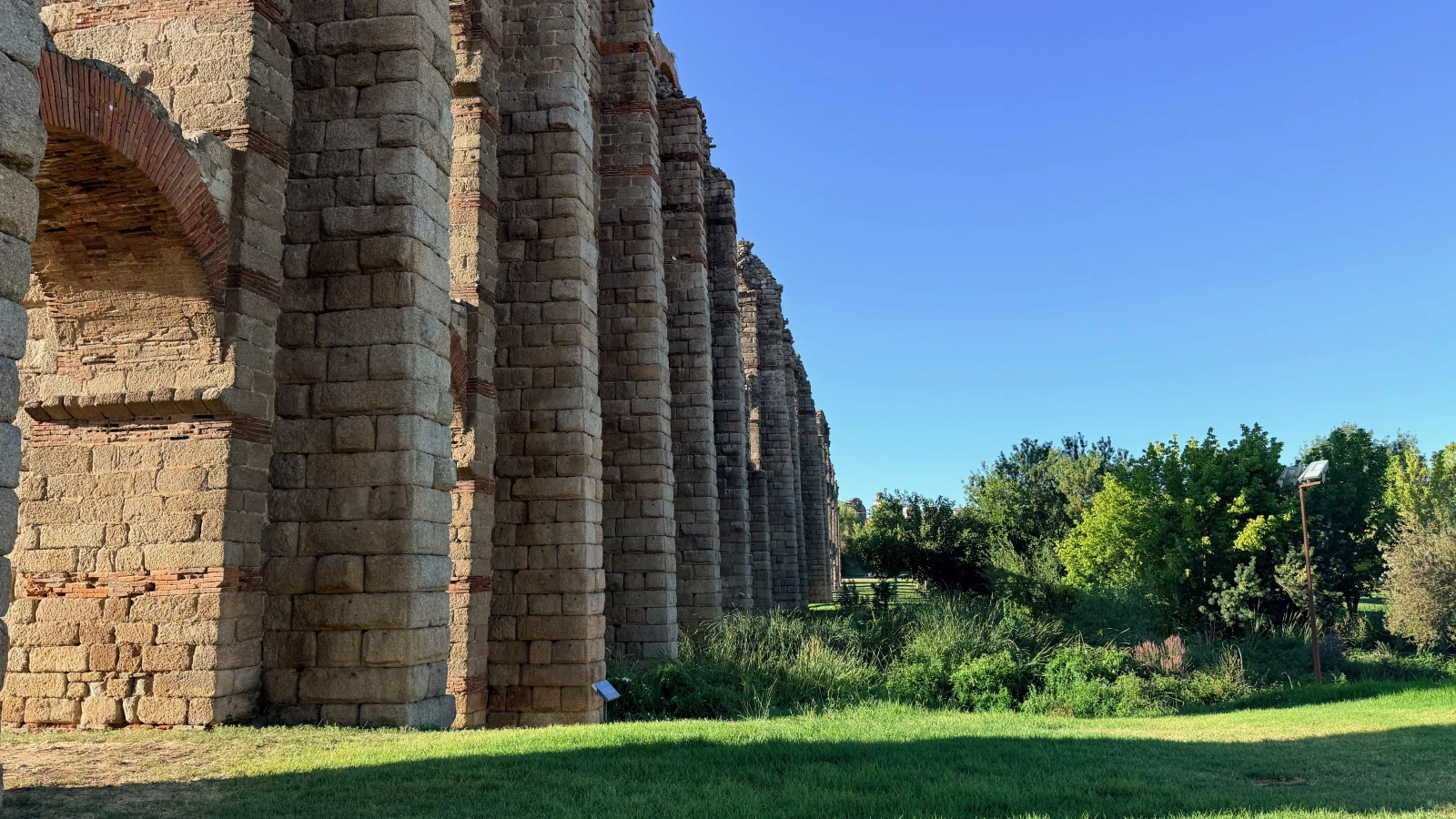
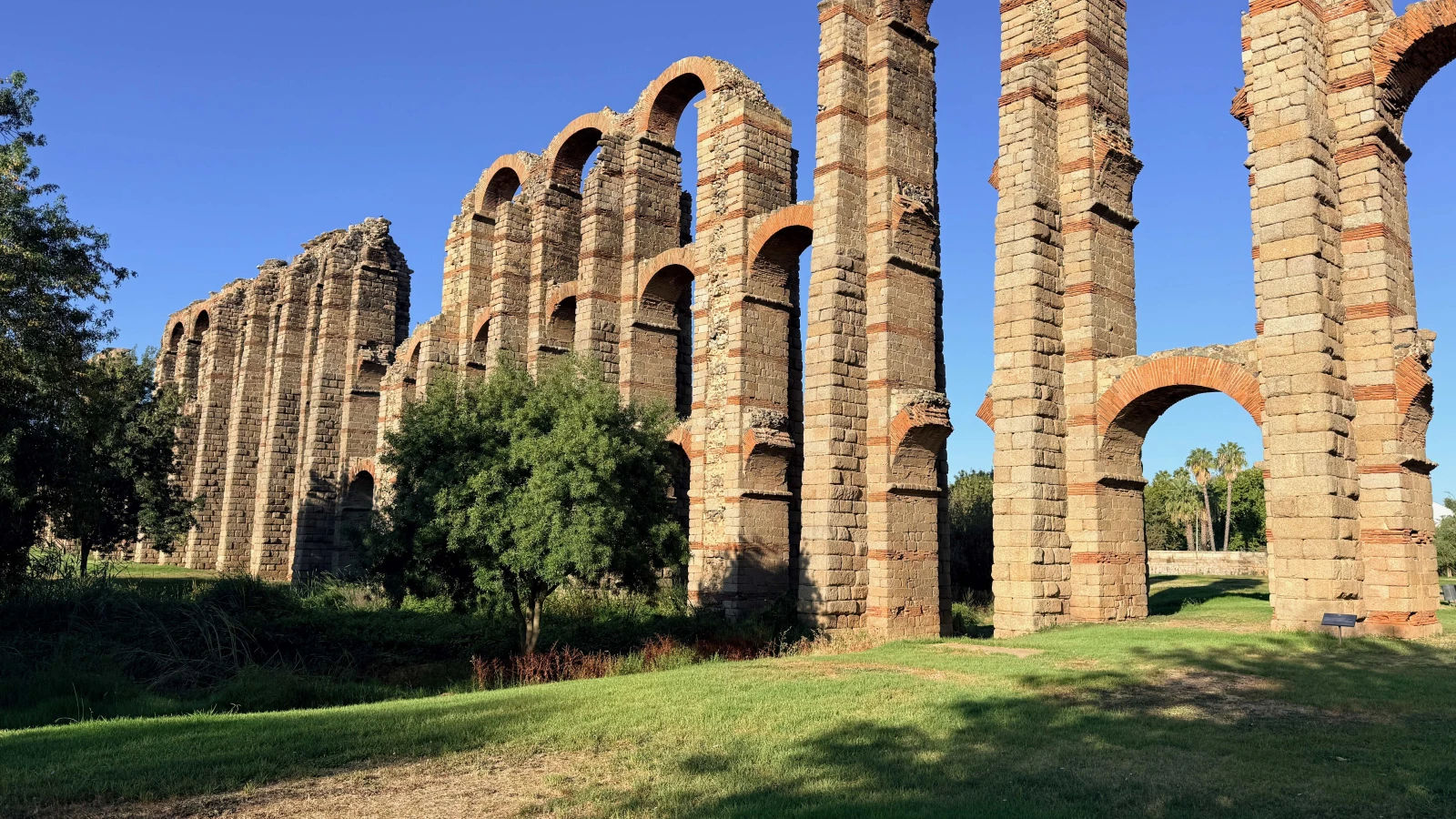
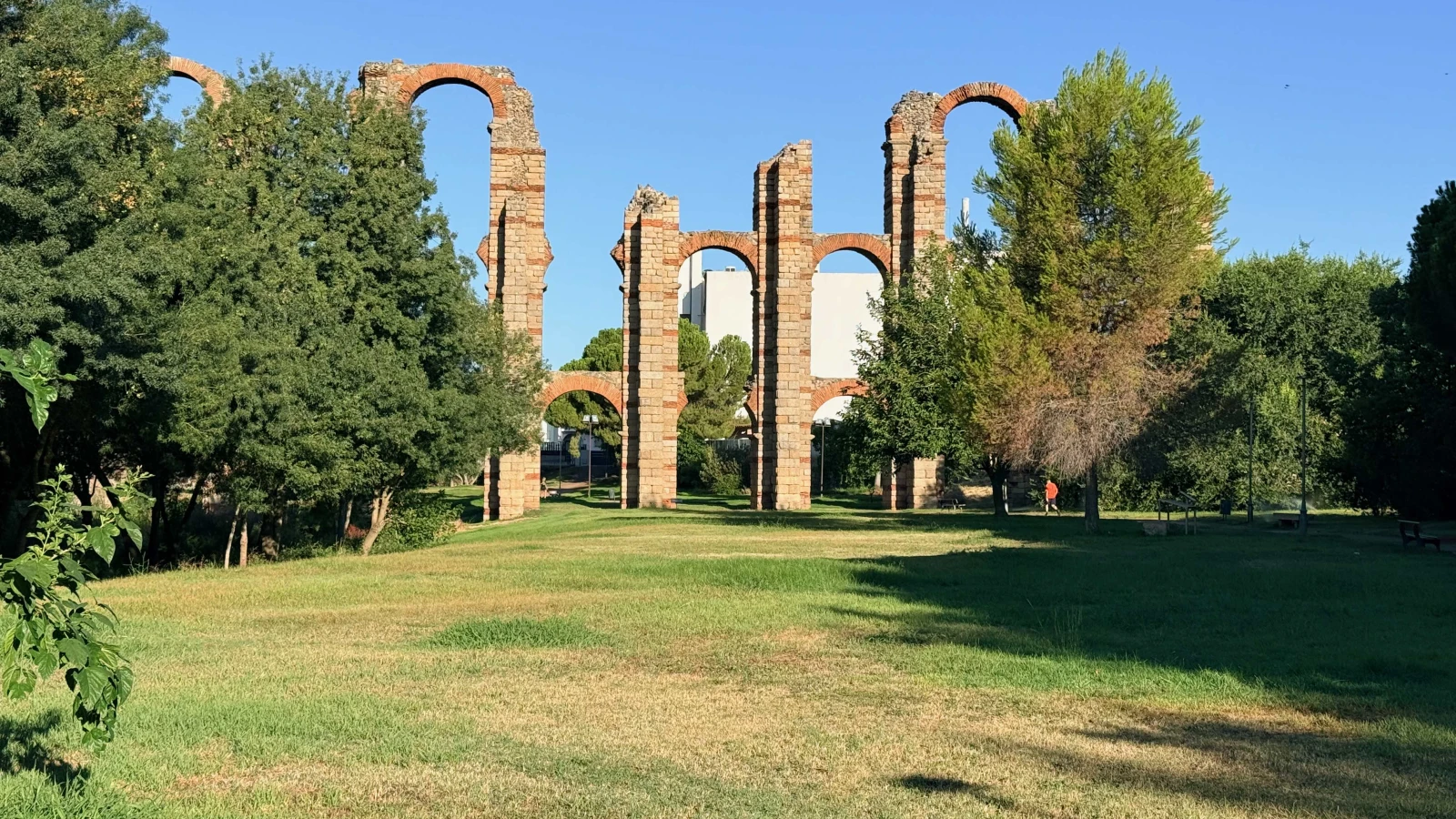
A little further out, to the north beyond the railway line, stands the place I keep coming back for: the Acueducto de los Milagros – the Aqueduct of Miracles.
That is what the people called it because they could not understand how something like this could possibly remain standing.
Twenty-five-metre-high pillars of granite and brick, striped like an old robe, standing in a meadow without fences, without ticket booths, without explanation.
And on every second pillar, a stork’s nest.
The storks are loud. They clatter their bills, quarrel and circle high above the arches, and you stand there with your dog in the dry grass thinking: Roman engineers built a water supply system, and two thousand years later it has become a paradise for birds.
No building ever knows what purpose it will one day serve.
What Has Changed
Do not imagine that Mérida is simply a collection of ruins with a few cafés around them. This city has changed enormously during my lifetime, and almost all of it for the better.
In 1983, Mérida became the capital of the newly created Autonomous Community of Extremadura – not the larger Badajoz, not the more distinguished Cáceres, but Mérida, because of its central location and its history.
With that came administration, civil servants, investment, and a population that no longer simply moved away. Around sixty thousand people live here today, and Mérida is one of the few cities in this sparsely populated region that is not shrinking.
In 1986, Rafael Moneo built the National Museum of Roman Art directly above Roman foundations, an immense brick hall with great rounded arches where light falls from above almost like it does inside a basilica.
It remains one of Spain’s most beautiful museums, and it set the tone for everything that followed: here, you do not build next to antiquity. You build with it.
In 1993, UNESCO added Mérida’s archaeological ensemble to the World Heritage List. Since then, the city has gradually been put in order.
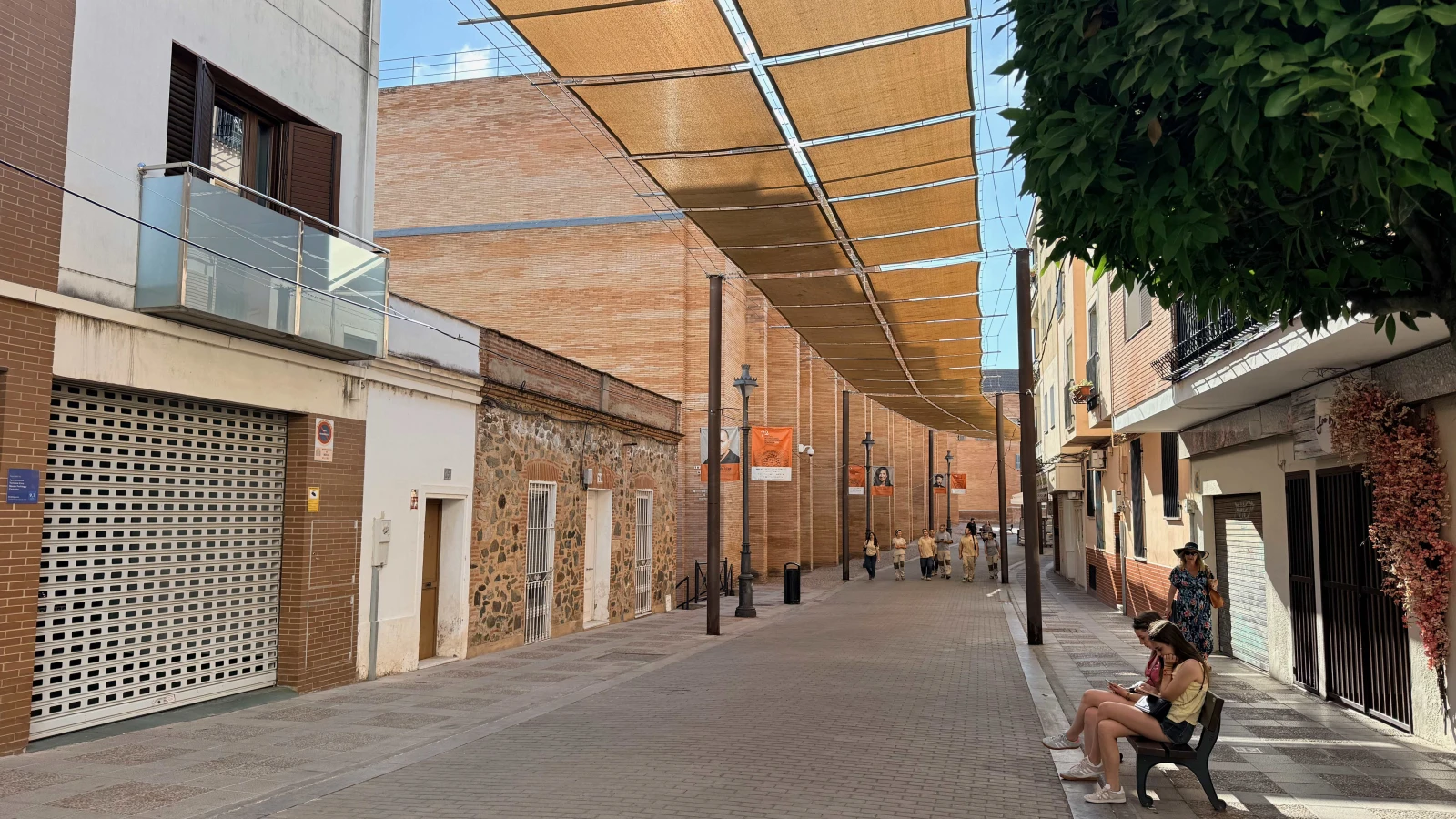
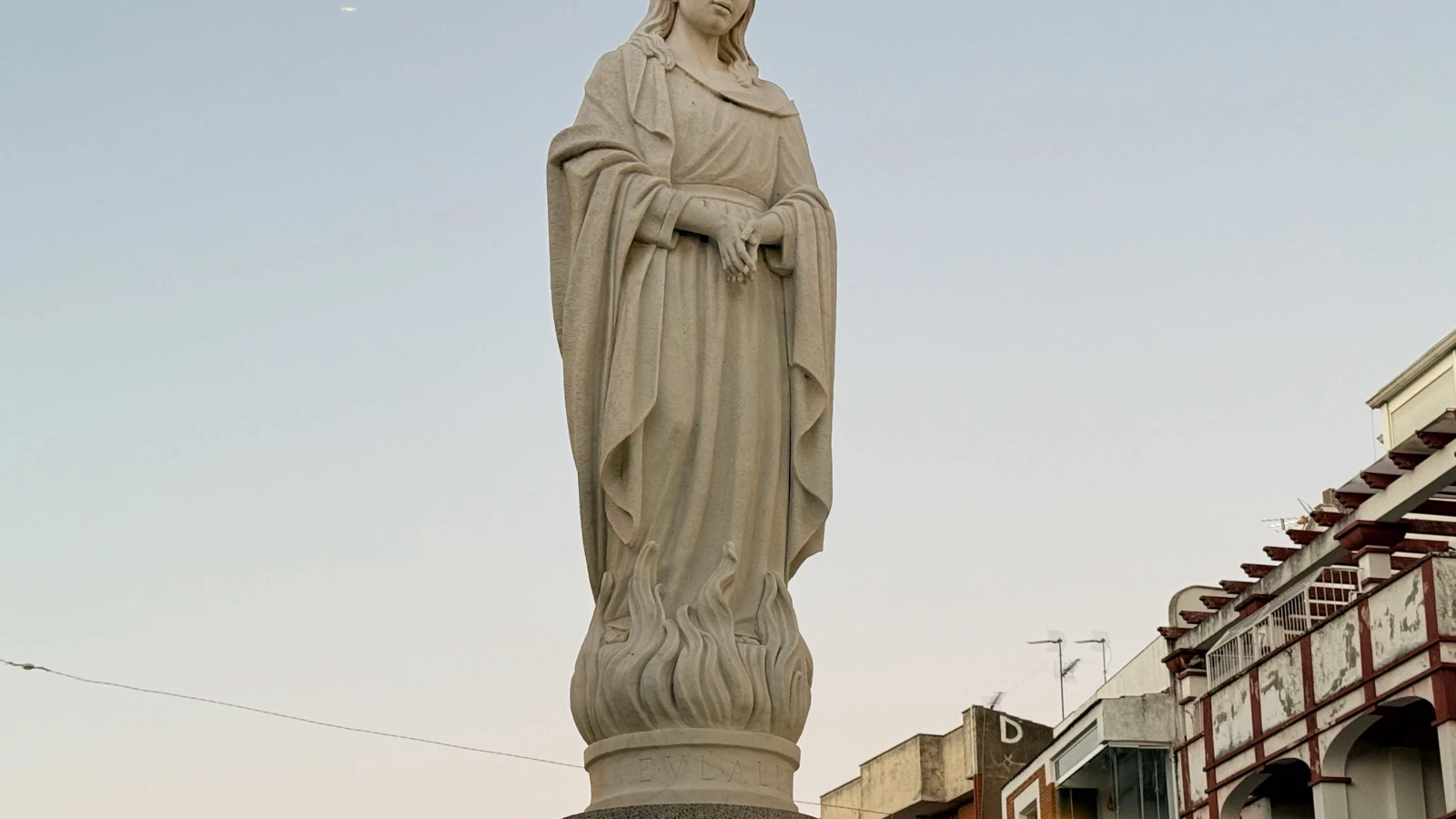
Much of the historic centre has been freed from traffic. Plaza de España and Calle Santa Eulalia are now pedestrian areas where half the city seems to come out for an evening stroll. Archaeological sites have been connected, signposted and made accessible – the Casa del Mitreo with its cosmological mosaic, the Columbarios, the Circus, the Amphitheatre.
And the riverside, once little more than wasteland and the neglected back of the city, has become the park where we were just walking.
Since 2022, faster trains on the Extremadura line have been stopping in Mérida. The region that for decades seemed to symbolise Spain’s isolation from the rest of the country is slowly moving closer to Madrid.
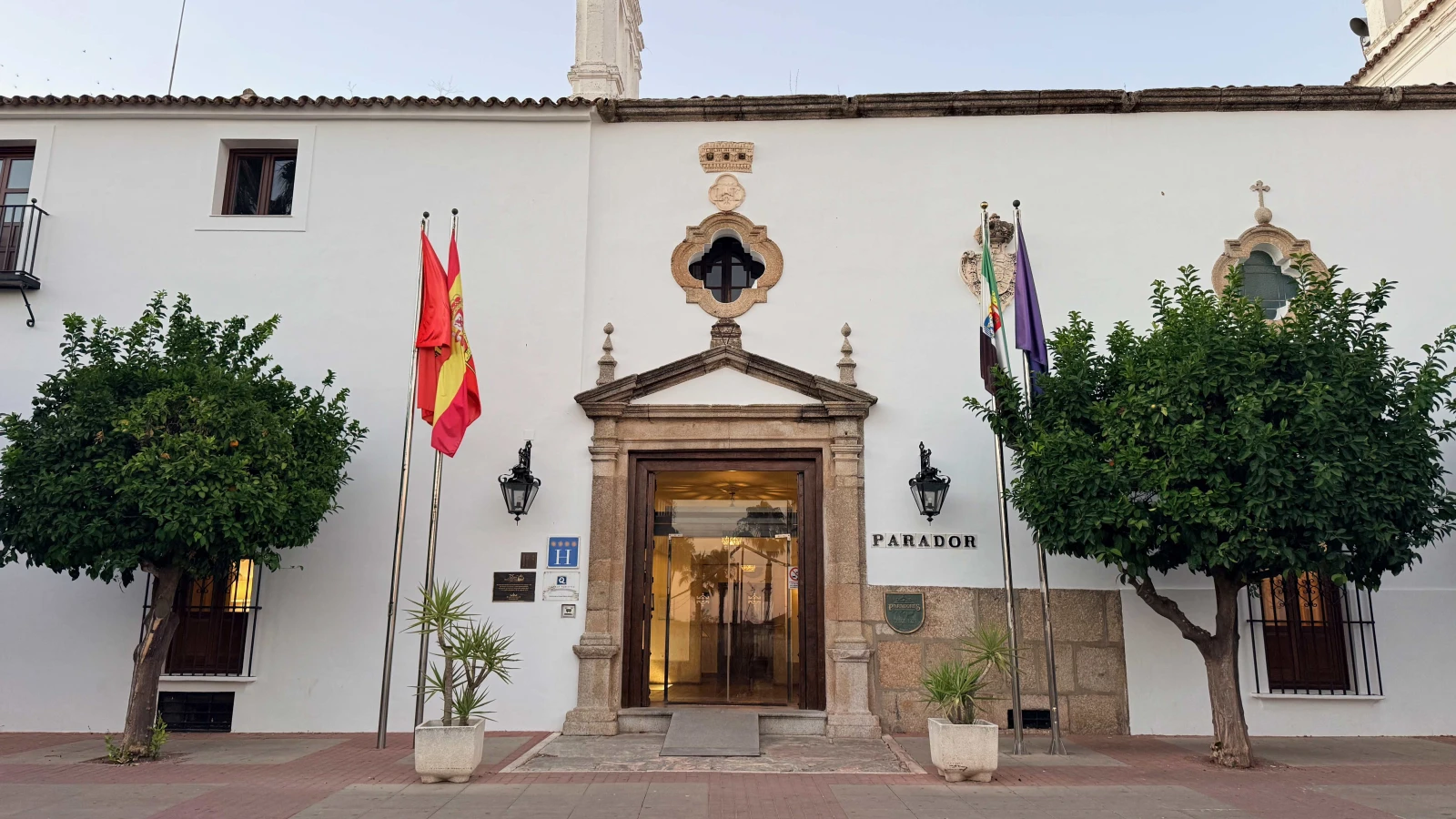
Out in the dehesa, solar parks stretch towards the horizon, while in the city small hotels have opened in old houses, along with wine bars and restaurants cooking with what grows and is produced here: Iberian pork from the oak pastures, Torta del Casar cheese, paprika from La Vera and cherries from the Jerte Valley.
And yet – and perhaps this is the real miracle – Mérida has not become touristy in the way that cities sometimes become touristy.
There are no endless queues, no souvenir strip, no city performing a staged version of itself.
At ten o’clock on an August morning, you can still have the streets almost entirely to yourself.
Anyone tired of the tourist caravan through Andalusia will find everything they are looking for here – only without the crowds.
Back
By eleven, the heat is becoming serious.
We walk back past Plaza de España, where the palm trees cast narrow strips of shade and old men sit on benches talking about nothing in particular.
I drink a coffee standing at the bar. Zuky gets water, half of which he spreads across the floor, and nobody says anything because dogs are simply part of the picture here.
Then back up through the streets, behind the shops, into the cool.
Outside, the granite glows. Inside, the light is dim, and the dog stretches out full length across the tiles and is asleep before I have even sat down.
In the evening, when the sun hangs above the Guadiana and the water turns the colour of brass, we walk down to the river once more.
That is when the city comes outside: everyone together, pushchairs and bicycles and dogs, while people walk home across a bridge that is two thousand years old.
I think evenings like this are when you come closest to understanding what an old city really is: not a museum, but a place where a great many people have been doing the same things for a very long time – walking across a bridge, going down to the water, and climbing back up again.
Come in spring or October if you want comfort.
Come in August if you want to understand why people here live the way they do.
Zuky and I, at any rate, are here.
Practical Information for Travellers with Dogs
Best times in summer: Before 10 a.m. and after 8 p.m. Granite and asphalt retain the heat, so check the temperature of the ground before setting out to protect your dog’s paws. Always carry water.
Best dog walk: The riverside park along the Guadiana between the Roman Bridge and the Lusitania Bridge is the best place in the city for walking a dog: shaded, traffic-free and with access to the water.
Monuments: The major monuments – the Roman Theatre, Amphitheatre, Alcazaba, Casa del Mitreo and the museum – generally only allow assistance dogs. Check the current rules with the Consorcio Ciudad Monumental before visiting.
Free and dog-friendly sights: The Temple of Diana, Arch of Trajan, Roman Bridge, Aqueduct of Miracles and the entire old town can all be enjoyed with a dog.
Getting there: Mérida railway station is served by the Extremadura line. The city is also easily reached by car from Seville, Cáceres and Badajoz. If driving, it is generally best to park outside the historic centre.
Rainer Schmitz




Comments